





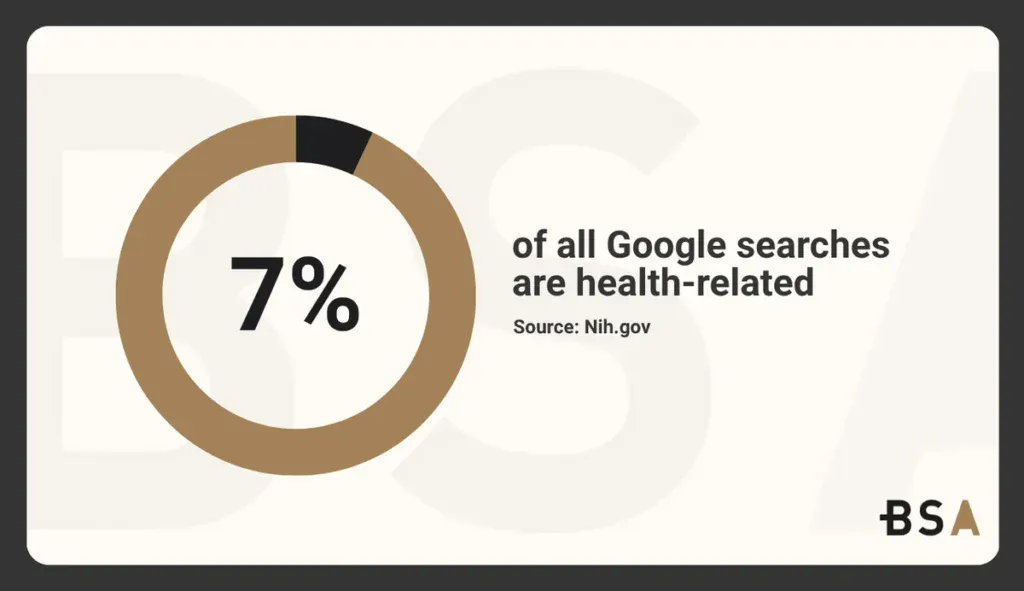
Approximately 7% of all Google searches are health-related.
This means that making sure your healthcare website is reaching as many patients as possible is vital. Schema markups for healthcare are generally overlooked due to seeming complicated and not as necessary as other parts of the website.
The reality is that schema markups can make a big difference in your healthcare website’s visibility by making it easier for Google to understand how your website functions.
For hospitals, clinics, and urgent care centers, schema markups offer the opportunity to not only get more potential patients, but they enhance trust and can optimize a patient’s journey.
When done right, schema markups transform your website content into machine-readable blocks of information that make it easy for search engines and AI assistants to interpret and display your content.
This article will go through why schema markup for healthcare is important, what schema markup is in the first place, and how you can create and implement your own.
Trying to add different schema markups for your healthcare website but don’t know where to start? Let us help.
What is Schema Markup?
Before we talk about why schema markup for healthcare is important, we first need to talk about what schema markup is so you can fully grasp its importance, especially for healthcare websites.
A schema markup, which is also known as structured data, is metadata that is inserted into your website to help search engines and AI assistants understand and contextualize your web content.
Whenever you use schema markup on your website, you are using the Schema.org vocabulary in a way that describes your webpage and how it relates to other webpages and their content from your own website and websites around the world.
This helps search engines understand what your webpage is all about and makes it easier for them to recommend your page to someone looking for a similar thing.
Why Schema Markup for Healthcare Matters
While schema markups are important for every business website out there, their immediate impact on the healthcare sector is far more significant.
This is because of the industry’s dependency on accuracy, authority, and local search visibility.
With millions upon millions of patients using Google for medical information, any sort of visibility improvement in search clarity will bring with it more appointments, stronger authority, and higher trust.
When implemented correctly, schema markup for healthcare can enable search enhancements like FAQ rich results, how-to results, provider profile cards, medical entity highlights, and more.
These improved search results attract a lot more attention than any standard blue link. In the healthcare industry, providers being compared is the norm, so any way your website stands out, such as with structured web results, the more likely it is that patients will choose your healthcare website.
What Types of Schema Markup Are Most Useful for Healthcare Websites
Although healthcare organizations can create and implement schema markups on almost all types of content, certain schemas suit them better.
The most important and foundational schema type for healthcare is by far the HealthcareOrganization schema, which lets you structure information about the medical facility, address, contact information, specialties, and accreditations.
When this is combined with a LocalBusiness schema, you are able to reinforce both the medical identity and the physical location of your hospital, or urgent care clinic effectively.
Another important schema commonly used for healthcare is the Physician schema and the MedicalOrganization schema, which mainly focus on provider profiles.
Patients want to know what doctor they are choosing before they get to the clinic or hospital, and these schema markups allow search engines to show credentials, education history, specialties, and affiliations.
All in a simple-to-follow format.
Provider profile schemas are very important for healthcare organizations with multiple locations to avoid confusion among them.
FAQ schema is widely used in healthcare due to how many questions patients tend to ask search engines.
When you implement it on service pages, appointment pages, and even treatment pages, you allow questions and answers to appear directly in search results.
This makes it so patients see your website as a source of helpful information and gain their trust from the start.
And finally, we have a schema for reviews, insurance information, appointment availability, telehealth options, and even organizational accreditations. These can all strengthen how search engines view your services.
How Schema Markups Improve Search Rankings and Patient Engagement
A schema markup will not act as a main ranking factor in a similar way that SEO plans do.
But it plays a powerful role in an SEO strategy by indirectly improving SEO performance. Search engines will always favor websites that are easy to crawl through due to good clarity, structure, and meaning.
One big SEO benefit of schema markup is that it enables rich results, which tend to attract significantly more click-through rates compared to normal links.
As more patients start engaging with your content through rich results, Google automatically starts seeing your website as an authority that is also reliable.
Schema markups can also improve patient engagement by creating an informative and effective search experience. Most patients don’t want to click through several pages just to find operational information.
With the correct schema, Google can display those hours directly in the search results, which saves them time.
This reduces overall frustration and helps your healthcare website stand out from competitors who haven’t worked on their schema markups yet.
Structured data also reduces ambiguity and potential misunderstandings due to healthcare terminology.
Names of procedures, medications, and medical conditions might often overlap with unrelated terms, and schemas help eliminate this confusion by defining your content in the context that matters for search engines.
Explore how we reduced Deep 6 AI’s bounce rate by 21% with a brand-new web design in our latest case study.
How to Create and Implement Schema Markup for Healthcare
The first step when it comes to creating schema markup for healthcare is to identify which pages and content types are the most important.
For the most part, healthcare organizations start with three foundational areas: the main organization page, provider profile pages, and core healthcare services pages.
Each of these sections plays a vital role in patient decision-making, which means that schemas have an even bigger impact.
1. Pick a Format
To create a schema markup, you first need to figure out what your preferred format will be.
Google supports JSON-LD, Microdata, and RDFa, but for 99% of cases, we recommend JSON-LD due to its ease of management since it doesn’t interfere with your website’s HTML.
Developers add JSON-LD schemas as a script within the page’s source code, and they can update or expand it at any time without altering the page structure.
2. Define Schema Type & Information
After you select a format, you have to define what schema type corresponds to each page.
As we mentioned before, healthcare organizations typically use HealthcareOrganization, MedicalOrganization, Physician, MedicalProcedure, MedicalCondition, and FAQPage as a base, then expand to others as needed.
Once you pick your schema type, you just have to start populating the fields with information from your website as needed. It’s vital for you to be consistent with your schema information to avoid confusing search engines and patients alike.
You should always use schema types that are directly relevant to the content on your page.
If you use the wrong schema on a page, it will only harm your page and website as a whole since it will see that schema as misused and ignore the page altogether.
Explore how we increased 12 Stone Church’s page speed score to 100% with a brand website in our latest case study.
3. Ensure Your Pages Are High Quality
Since medical information falls inside the YMYL (Your Money Your Life) standards, Google will apply higher scrutiny to healthcare schemas. This means that you should support all of your structured data with high-quality and authoritative content on the page.
Schema markup won’t compensate for a lack of content on a page, inaccurate information, or a lack of medical oversight.
This means that your healthcare website needs well-researched, medically reviewed content to fully benefit from structured data strategies.
Once the markup is in place, use testing tools to ensure that there are no errors and that the structured data is eligible for rich results.
Pages such as Schema Validator and Google’s Rich Result Test are the go-tos for this phase.
Then proceed to publish the pages and monitor their performance with Google Search Console.
Schema markup maintenance is just as important as implementing it.
Because healthcare data consistently changes, ensuring that all of the information is up to date is a must if you want your schema to work properly.
Best Practices and Common Mistakes
The number one best practice when it comes to schema markup for healthcare is maintaining a one-page-one-primary-entity mindset, connecting entities via stable @id references, and aligning all marked-up information with visible page content.
Accurate, consistent, and up-to-date data are non-negotiable, especially in the healthcare industry where false information can get you in trouble and mislead patients.
When it comes to mistakes, making up reviews that are hosted off-site can violate a lot of guidelines and lead to potential issues.
Using generic schema types when a more specific and useful schema is available can lead to less visibility.
Inconsistent hours, old provider profiles, or mismatched addresses between schema and your Google Business Profile can also lead patients to distrust your healthcare facility as a whole.
When creating your schema, consider the bigger picture.
Don’t just create schemas and call it a day; consider making a complete content strategy and page restructuring with schemas in mind so that they are effective.
Remember, schema markup can’t compensate for thin, inaccurate, or outdated content. It only amplifies well-structured, patient-focused content that is medically reviewed.
What Does This All Mean for the Future of Healthcare Search?
As search engines continue to evolve, especially AI assistants, the role of schema markup in healthcare becomes increasingly important.
In voice and chat queries like “urgent care open now near me,” search systems rely on structured facts rather than the raw page content alone.
As healthcare providers increase their digital footprint through different niches such as telehealth, provider networks, and hybrid care models, the ability to respond to bigger patient queries via structured data will start to become the main differentiator in digital competitiveness.
This means that healthcare organizations that treat schema markups as a key part of their SEO strategy rather than a one-time job will be set for the future.
Those who ignore structured data may start noticing that their visibility is going down as their competitors keep growing.
Get a Custom Healthcare Website that Converts With Blacksmith
Knowing the importance of schema markup for healthcare is only the first step. Understanding which schema is needed for every page and applying it accordingly takes a lot of research and knowledge.
This schema project could take you weeks to complete. That’s without even counting maintenance and other aspects such as SEO that directly impact schema markup for healthcare.
This is all time you could be using on other aspects of your business, so what now?
That’s where we come in. Blacksmith is a healthcare website design agency with seasoned web designers and developers ready to build a brand new website for your healthcare facility.
We will ensure that your SEO strategy directly involves schema markups instead of leaving them as an afterthought. This will make it so they provide as much value for your website from day one.
Still unsure if getting a custom website is what your healthcare facility needs to continue growing?
Don’t worry, click here to schedule a call with us and we’ll provide you with a complete brand and website audit. This way we can show you where you’re losing potential patients and how a brand-new website can improve your patient acquisition drastically.