


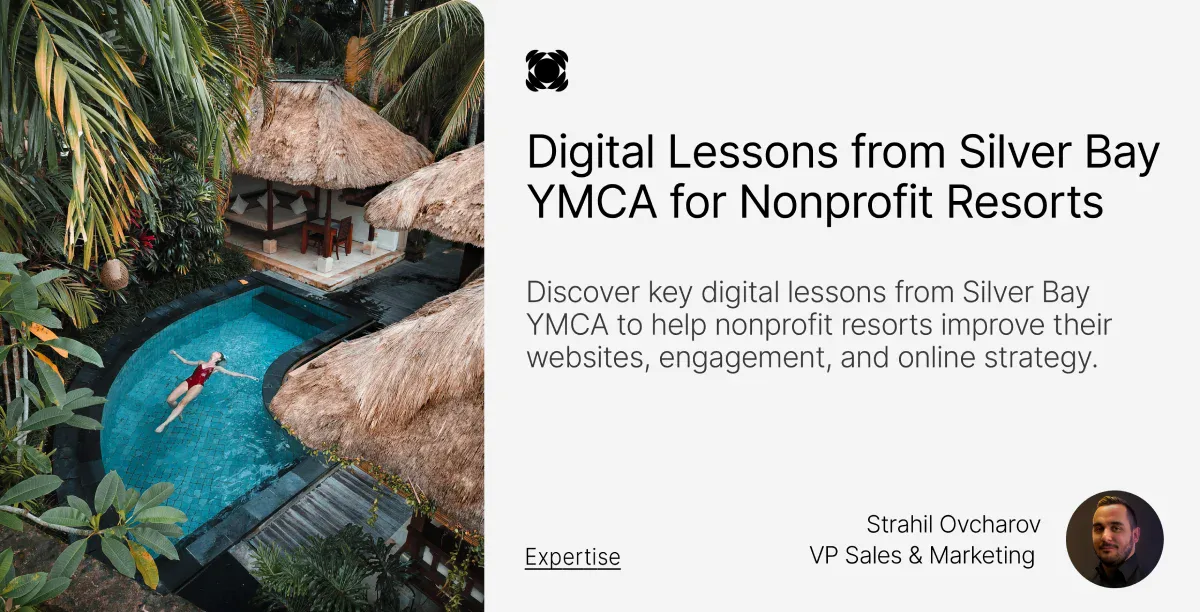
In the resort and recreation world, every guest journey begins online. For a property like Silver Bay YMCA, where lodging, conferences, youth camps, and lakeside recreation intersect under one mission-driven brand, the website has to sell both experience and purpose.
At Blacksmith Agency, we performed a comprehensive competitive analysis of Silver Bay’s digital footprint alongside leading peers such as YMCA of the Rockies, The Sagamore Resort, and Trout House Village Resort. Each operates in the same broad category of destination lodging: they market rooms, event venues, dining options, and curated experiences that bring guests back year after year.
Our research revealed five opportunities for Silver Bay to elevate its online presence. Turning a static informational site into a revenue-generating hospitality platform that mirrors the care guests feel on-site.
1. Navigation That Mirrors the Guest Journey
Hospitality websites are extensions of guest services. When travelers search for “lakefront rooms near Lake George” or “Upstate New York retreat centers,” they’re not browsing; they’re shopping for experiences.
Today, Silver Bay’s site blends camp programs, overnight lodging, faith retreats, and nonprofit initiatives into one navigation, forcing users to sort it out themselves. As Lucas Callahan, VP of Guest Services, admitted, “The biggest issue is people don’t know what we are. Even professionals in the area thought we were a kids’ camp.”
By contrast, YMCA of the Rockies funnels visitors immediately into Family Cabins, Conference Groups, and Outdoor Programs, each with its own conversion path. A model rooted in hospitality information architecture.
Kris Mitchell summarized the opportunity: “Navigation should funnel audiences by intent, turning confusion into clarity and visits into conversions.”
On a future Silver Bay site, that means a homepage that asks, “What brings you to Silver Bay?” followed by three pathways:
Stay: Browse rooms, cottages, and meal plans.
Gather: Explore weddings, conferences, and retreats.
Grow: Learn about youth camps, programs, and membership.
Each path should feature a booking CTA (“Check Availability,” “Plan Your Event,” “Join a Program”) so users always have a next step.
Takeaway: Resort navigation must mimic a concierge’s conversation. When the site anticipates guest intent, such as lodging, group booking, or event planning, it sells more stays and fills more calendars.
2. Translating Brand Story into Guest Emotion
Hospitality brands sell feelings before they sell beds. We captured this idea when we said, “We need to put Lucas on the website without putting Lucas on the website.”
That means translating the warmth of Silver Bay’s staff into a digital brand language, photography, tone, and interface that radiate hospitality.
Competitors like The Sagamore Resort use what Brett calls design familiarity: polished imagery of lakefront verandas, lifestyle videos of weddings, and rich interior shots that mirror their real-world luxury.
Silver Bay’s current visual palette, static photos, muted typography, and generic stock layouts undersell its unique assets: Adirondack-style architecture, a 700-acre waterfront campus, multi-generational programming, and a century-old history.
A redesigned site could weave these brand pillars into immersive storytelling blocks:
Video tours of cabins and lodges at golden hour.
A “Meet Our Staff” carousel highlighting hospitality leadership.
Interactive maps connect guests to waterfront activities.
Takeaway: In hospitality, design equals emotion. When visuals mirror the experience, campfire light, lake reflections, smiling faces, guests begin their journey before arrival.
3. Technical Performance as Digital Guest Service
Hospitality guests expect immediacy. If a resort website takes longer than three seconds to load, potential bookers often abandon it for Expedia or Booking.
Silver Bay’s site scored below 30 on mobile speed tests. Kris Mitchell noted, “If your site isn’t fast, that’s going to cause all kinds of issues.” Those issues translate directly into lost bookings, especially for spontaneous weekend travelers.
Meanwhile, The Sagamore and YMCA of the Rockies succeed partly because they use lightweight page frameworks optimized for booking-engine integrations; their search widgets, rate calendars, and payment gateways load seamlessly across devices.
Silver Bay’s digital infrastructure should mirror that standard. Core Web Vitals must be tuned for real-world performance.
Sub-3-second largest Contentful Paint (LCP) on mobile.
Integrated analytics tracking for booking and donation funnels.
Cloud hosting that scales during seasonal surges.
Equally vital is ADA/WCAG 2.1 compliance, which is not just for legal protection but as a reflection of YMCA values. Alt-tagged imagery, keyboard navigation, and proper color contrast signal inclusivity, ensuring every guest with low vision, can explore and book confidently.
Takeaway: Site performance is the new front desk. A fast, accessible, mobile-optimized platform shows guests the same responsiveness online that they expect in person.
4. Designing for Conversion, Not Just Visibility
For decades, resorts chased search rankings; now, Google rewards engagement and conversion. We explained, “Google no longer focuses on findability; instead, it focuses on conversions. People will find you. The question is: do they stay?”
Silver Bay’s analytics reveal high bounce rates and short session times, symptoms of a site that informs but doesn’t inspire action. Competitors convert better because they align content with purpose.
The Sagamore embeds booking widgets under every room description.
YMCA of the Rockies uses dynamic inquiry forms segmented by event type.
Trout House Village Resort links each cottage photo to an instant “Check Availability” pop-up.
Silver Bay’s redesign should embed conversion architecture into every page. Example:
For the Weddings & Events section, a “Start Planning Your Retreat” form captures the date, group size, and amenities, feeding directly into Salesforce or HubSpot.
On Lodging, each room tile features a “Book Now” button tied to real-time rates from the property management system (PMS).
On Programs, users can register or donate without leaving the page.
By tying these CTAs to behavioral analytics, the team can measure conversion rate optimization (CRO) just as precisely as the occupancy rate.
Takeaway: In the resort industry, the website is the sales office. Every scroll should bring a guest closer to a booking, event inquiry, or donation, not just another page view.
5. Storytelling & Usability: Selling Experiences, Not Pages
Resort websites no longer compete on amenities alone; they compete on narrative. Travelers want to imagine themselves kayaking, worshiping at sunrise, or reconnecting at a family reunion.
Wel emphasized, “People perceive Silver Bay as a hodgepodge. We want to help them interact, not interpret.”
That’s where interactive storytelling comes in. We showed Silver Bay a case study from Bonanno Concepts, a Denver restaurant group whose website fuses texture, motion, and narrative to make users feel immersed in each location.
Silver Bay can achieve the same through:
“Create Your Stay” personalization tools: guests select the purpose of their visit (family vacation, retreat, conference) and get a curated itinerary of rooms, meals, and activities.
Dynamic event showcases: upcoming conferences, seasonal retreats, and youth programs rotate on the homepage to drive sign-ups.
Real-guest testimonials: short quotes overlaying lifestyle imagery to build authenticity.
This approach resonated immediately. “I could see this being a great tool for groups,” said Talia, Silver Bay’s marketing lead. “Whether it’s a wedding or a family reunion, we could even fold programs into it.”
Takeaway: Hospitality storytelling should be interactive. When users can see, feel, and customize their journey, the site stops being a brochure and starts being a booking engine for experiences.
6. Competitive Benchmarks: Where Silver Bay Stands
Our side-by-side scoring placed The Sagamore Resort first overall in digital maturity, commanding roughly 50% of available market traffic. YMCA of the Rockies ranked second for UX design and conversion funnels. Trout House followed with strong brand character but outdated technology. Silver Bay, at 1.5% market share, showed clear potential but major usability gaps.
Strengths included credible backlinks from The New York Times and AllTrails, validating their regional relevance. Weaknesses centered on mobile UX, page speed, and SEO structure.
Closing these gaps requires unifying Silver Bay’s dual identities: resort and mission. A refreshed website can position it as both a premier Adirondack destination and a values-driven nonprofit, blending commerce and community under one umbrella brand.
Takeaway: Competitive differentiation in hospitality isn’t about size; it’s about coherence. When the user journey, brand promise, and conversion flow align, even smaller properties can outperform larger resorts.
From Retreat Center to Digital Destination
Silver Bay YMCA isn’t just a resort; it’s a century-old community on the shore of Lake George that sells serenity, service, and shared purpose. Its next growth phase depends on bringing that atmosphere online with the same care its staff brings to every guest check-in.
Kris Mitchell summarized it best: “We’re not just creating a website. We’re creating the building blocks for a successful project, one that reflects who you are and how guests experience you.”
The roadmap is clear:
- Segment navigation by user intent to reduce friction.
- Visualize the brand through storytelling that reflects genuine hospitality.
- Upgrade site performance as an extension of service quality.
- Integrate conversions into every page and program.
- Infuse usability with empathy and interactivity.
By measuring twice and cutting once, Silver Bay can move from being a well-kept secret in the Adirondacks to a model for digital transformation in mission-based hospitality.