




Did you know that 96% of website visitors leave without buying anything?
The numbers tell an interesting story. It suggests that a website may look great, but still not be enough to boost brand conversions.
Data proves that a technically superior website redesign can boost conversions by as much as 400%. Even better? Every dollar you invest in improving the user experience returns $100.
Those aren’t just impressive statistics. They’re proof that your website design can either make or break your bottom line.
You can drive thousands of visitors to a website with traffic ads, but if the website is broken, they’ll still leave empty-handed. Clearly, your design needs to work harder at every customer touchpoint so browsers can quickly become buyers.
This guide breaks down exactly how website redesign can boost conversions and sales and deliver results you can actually measure.
Key Takeaways
- Replace creative guesswork with Conversion Rate Optimization (CRO) data during your redesign to identify revenue leaks and base structural changes entirely on actual user behavior.
- You must prioritize page load times and a strict mobile-first architecture to prevent the high bounce rates and cart abandonment that destroy mobile conversions.
- Reduce user decision fatigue by limiting your main navigation to five to seven categories and utilizing high-contrast UI design to guide visitors directly to your primary calls to action.
- Strip away unnecessary form fields to reduce the user effort required to complete a purchase.
- Treat your launch date as day one by continuously tracking important metrics to ensure your new design consistently maximizes ROI.
What is Conversion Rate Optimization, and Why Does It Matter?
Ads cost money.
But spending thousands on aggressive ad campaigns and SEO does not automatically qualify you for a return on investment. You can drive 10,000 visitors to your site in a month, but if none of them buy anything, that marketing budget just disappeared into thin air.
That’s where conversion rate optimization (CRO) comes in.
CRO is the systematic process of increasing the percentage of website visitors who complete a desired action. Your conversion rate shows how many visitors actually take the action you want them to take.
The calculation is straightforward. Divide the number of conversions by your total visitors, then multiply by 100. For example, if 2,000 people visit your landing page and 200 sign up for your service, you have a 10% conversion rate.
Conversions are of two types: macro conversions and micro conversions. Macro conversions represent the big wins like completing a purchase, submitting a quote request, or subscribing to your service.
Micro conversions track smaller steps that move people closer to buying, like creating an account, adding items to a cart, or joining your newsletter. Both matter because they show you exactly how users move through your site.
According to a report by Think with Google, the mobile experience is now the primary battleground for these conversions, where even a millisecond of lag destroys consumer confidence.
While ecommerce sites typically convert between 2% to 5% of visitors, B2B companies see rates from 1% to 2%. Your specific rate depends on your audience, what you’re offering, and how good your user experience actually is.
Here’s where things get interesting.
Many companies see 223% ROI from CRO investments, according to VentureBeat. Returns can exceed 1,000% under the right circumstances. The impact on customer acquisition costs is just as substantial.
When you optimize for better conversions, you pay less to acquire each customer. You get more value from your advertising spend because more visitors complete purchases or submit leads, creating sustainable growth for the brand
Despite the obvious advantages, fewer than 40% of companies have a documented CRO strategy.
Why Every Website Redesign Needs a CRO Strategy
While most creative agencies treat a redesign as a superficial facelift, focusing on aesthetic trends that often bloat your code and decimate your page speed, a Blacksmith-engineered redesign operates on a different mandate.
We replace creative guesswork with Conversion Rate Optimization (CRO) data to identify exactly where your current infrastructure is hemorrhaging revenue.
By embedding CRO strategies into the redesign process, every decision serves a structural purpose beyond aesthetics. This data-backed intervention ensures you aren’t making decisions based on assumptions, but on actual user behavior analysis.
While traditional redesigns often suffer from a post-launch performance dip as search engines and users adjust, a CRO-integrated approach mitigates these risks.
By identifying and solving friction points during the build, we ensure your conversion rates climb immediately post-launch, turning a technical transition into a high-velocity growth event.
Top Website Redesign Tactics To Boost Conversions

Five core elements separate websites that make money from those that don’t. Each one tackles specific problems that stop visitors from taking action.
1. Page Speed and Load Time Optimization
That extra second your page takes to load? It’s costing you money.
Pages loading within 2 seconds see bounce rates around 9%, while those taking 5 seconds jump above 38%. A single second delay drops conversion rates by 7%. If your website generates $100,000 annually, cutting two seconds from load time could add $8,000 to your revenue.
Speed improvements pay off immediately. Retail brands saw conversion increases of 8.4% from just a 0.1-second loading improvement. Google PageSpeed Insights sets the bar at 2.5 seconds, and hitting that target requires some work.
Our technical redesigns prioritize:
- Next-Gen Image Compression: Utilizing WebP and AVIF formats to maintain 4K visual fidelity at 10% of the file weight.
- Browser Caching: Returning visitors load your site faster when their browser stores certain files.
- Fewer HTTP Requests: Combine CSS and JavaScript files to reduce server calls.
- Content Delivery Networks: Serve content from servers closest to your users.
2. Mobile Responsiveness
With 60.43% of all web traffic originating from mobile devices, a responsive site is no longer enough. You need a mobile-first architecture. Users operate smartphones one-handed; if your primary CTA is in the top-left corner, you have already lost the conversion.
A strategic website redesign can boost conversions by ensuring tap targets are at least 44×44 pixels and that the checkout process utilizes auto-fill APIs. This reduces the finger friction that leads to cart abandonment, potentially boosting mobile conversion rates by 27%.
3. Clear Navigation Structure
Stick to 5-7 main navigation categories. This reflects how much information people process without decision fatigue. Confusing navigation increases task difficulty by 21% and makes users take 39% longer to complete actions.
We know this matters because 76% of consumers say finding what they want easily is the most important website factor. Improve your navigation structure by using;
Decision fatigue is the enemy of the sale. When you present a user with a chaotic menu of 15 options, their brain exits. Such confusing navigation increases task difficulty by 21% and makes users take 39% longer to complete actions.
Stick to 5-7 main navigation categories. By implementing sticky navigation and visual breadcrumbs, you reduce the task difficulty for the user. Likewise, you can opt for clear, descriptive labels over creative menus and add search functionality to help visitors find specific items quickly.
4. Visual Design and User Interface
Professional UI design builds credibility instantly. You have exactly five seconds to answer three questions for a visitor:
- What do you offer?
- How does it make my life better?
- What do I do next?
If done well, UI can boost conversion rates by almost 200%.
An expert website design agency uses contrast, scale, positioning, and whitespace to guide the eye toward the calls to action. We stick to a defined palette that reinforces your brand and ensures the Unique Selling Proposition (USP) is the loudest element on the page.
5. Trust Signals and Credibility Markers
Trust signals eliminate doubt and prove you’re running a legitimate business. They can also increase conversions by up to 42%. That’s not small change. It’s the difference between a website that pays for itself and one that drains your marketing budget.
- SSL Certificate: Your site needs an SSL certificate for security, indicated by ‘https’ in the URL.
- Payment Options: Display trusted payment options like Visa, Mastercard, and PayPal at checkout.
- Security badges: Norton or TrustedSite badges help certify your site is malware-free.
- Real Testimonials: Names and photos consistently outperform anonymous quotes, so make sure to add them to your testimonials.
- Case Studies: Use case studies to demonstrate concrete results and include customer endorsements.
- Contact information: Add your physical address, phone number, and team photos to prove your business is real and reachable.
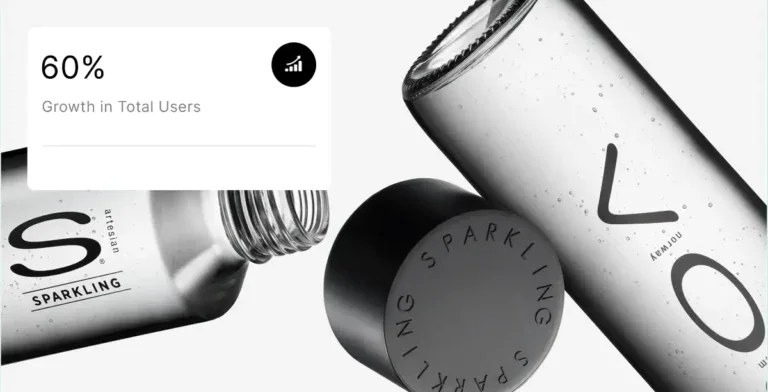
Is your current site leaking revenue? Discover how we increased Voss Water’s page views by 43% through a strategic, conversion-first technical redesign.
Best Web Design Practices to Boost Sales

Once the foundation is set, we deploy high-conversion tactical elements that transform visitor behavior into a predictable revenue stream.
1. Strategic Call-to-Action Placement
Your CTA needs visibility without forcing itself before visitors understand your value. Above-the-fold placement works when you pair it with a clear headline, supporting subheader, benefit statement, and urgency element.
You can increase conversions by 41% when you move CTAs above pricing grids. This works because 90% of visitors who read a headline also read the CTA, following natural reading patterns.
Use contrasting colors and generous whitespace around buttons draw attention. Skip generic copy like “Submit” and go with action-oriented text like “Get My Free Quote” instead.
2. Simplified Contact Forms and Checkout Process
Every form field you add reduces your conversion rate by 11%. If your contact form has 10 fields, you are essentially asking your customers to do unpaid data entry. Forms with 3-5 fields reduce user effort substantially.
We recommend three to five fields maximum for lead generation. For checkout, the Guest Checkout option matters more than you realize. 63% of shoppers abandon carts when forced to create an account. Instead, narrow your checkout flows to just 7-8 fields, down from the typical 14.
Multi-step forms with progress indicators improve completion rates. They break overwhelming processes into manageable chunks while smart defaults and inline validation prevent frustration from delayed error messages.
3. Above-the-Fold Content Optimization
Your above-the-fold section determines bounce or scroll decisions within seconds. You should include your unique selling proposition, primary messaging, navigation, and a clear CTA.
Test your content with the 5-second rule. Visitors should grasp what you do and who benefits in five seconds or less. Mobile optimization remains non-negotiable. Proper responsive design ensures content adapts to any screen size.
4. AEO (Answer Engine Optimization) Readiness
In 2026, AI agents like Gemini and Perplexity are citing your site for your customers. If your site architecture is too complex, these agents cannot find the data they need to recommend to you.
A modern redesign uses Schema Markup and Structured Data to communicate with these AI engines, ensuring your brand appears in AI-generated answers and voice searches.
5. White Space and Visual Hierarchy
Visual hierarchy guides attention to conversion elements through size, color, and contrast. Limit color use to 2 primary and 2 secondary colors, with no more than 3 contrast variations. Three size variations (small, medium, large) keep hierarchical relationships clear.
On the other hand, whitespace around CTAs and headers prompts user action. It reduces visual clutter.
6. Social Proof and Testimonials Integration
Customer testimonials can increase conversion rates by 270% when displayed well. Place testimonials near CTAs or conversion points for maximum effect.
Credible testimonials include real names, photos, company details, and specific measurable results. Video testimonials capture authenticity that text simply can’t match.
7. A/B Testing Different Design Elements
Test CTA placement, button colors, form length, and page layouts one at a time. Run tests for at least 1-2 weeks to account for behavior fluctuations. Track metrics like conversion rate, click-through rate, and revenue per visitor to measure the effect.
Even minor changes to button text or placement can deliver conversion lifts exceeding 30%.
8. Behavioral Retargeting
A redesign allows you to implement sophisticated tracking pixels and API integrations.
When a user leaves your site, your redesign should have already categorized their interest level. This allows you to serve hyper-targeted ads that drive them back to a high-conversion landing page with zero navigation links, designed solely to capture that specific lead.
Measuring Success After Your Website Redesign
The launch of your redesigned site is the beginning of the project, not the end. Real user data only shows up once your website goes live. This makes post-launch tracking essential for understanding whether your redesign works as expected.
To ensure a website redesign boosts conversions consistently, you must transition into a phase of rigorous measurement and governance.
Key Metrics to Track Post-launch
Be careful not to focus on vanity metrics like likes and shares to determine if your launch was successful. Instead, focus on numbers tied directly to business goals.
Organic traffic tells you whether search engines recognize your improvements. Track engagement rate to see if visitors interact with multiple pages rather than bouncing immediately. Conversion rates remain your primary indicator of whether the redesign meets objectives.
Core Web Vitals and page load times directly impact both user experience and search rankings. Tools like Microsoft Clarity identify exit points, rage clicking instances, and unusual scrolling patterns that signal friction. Monitor bounce rate, time on site, and pages per session to gauge content effectiveness.
Meanwhile, you need baseline data before your website launch. Compare traffic acquisition reports in GA4 with your baseline data for organic traffic changes. Use explorations to analyze landing page performance differences. Make sure your team examines consistent information by clarifying data sources.
Pre-post comparison validates your investment and highlights what content resonates.
Continuous Optimization and Iteration
Website performance optimization operates cyclically, not once. Base changes on real user behavior through data-driven decision making.
Set up reporting cadence with clear responsibility assignments. Iterative testing promotes continuous improvement by creating regular feedback loops. Your website evolves as you identify issues, prioritize fixes through analytics, and test solutions.
The best websites never stop improving. They use data to make smart decisions, test those decisions, and repeat the process.
Why Blacksmith Agency is the Definitive Website Redesign Agency
Your website redesign won’t magically fix everything overnight.
The truth is, even the best redesigns need time to show their full potential. You’ll likely see some immediate improvements, but the biggest gains come from what you do after launch.
Here’s what we’ve learned working with businesses of all sizes: the companies that see the most dramatic conversion improvements treat their launch date as day one, not the finish line.
Ready for a website redesign project that can boost conversion and sales?
At Blacksmith Agency, we specialize in building websites that boost your ROI. As an expert website redesign agency, we combine strategic design with proven conversion tactics to help businesses boost their sales through their websites.
Want to see what’s possible for your business? Let’s chat about turning your website into your best sales tool.