





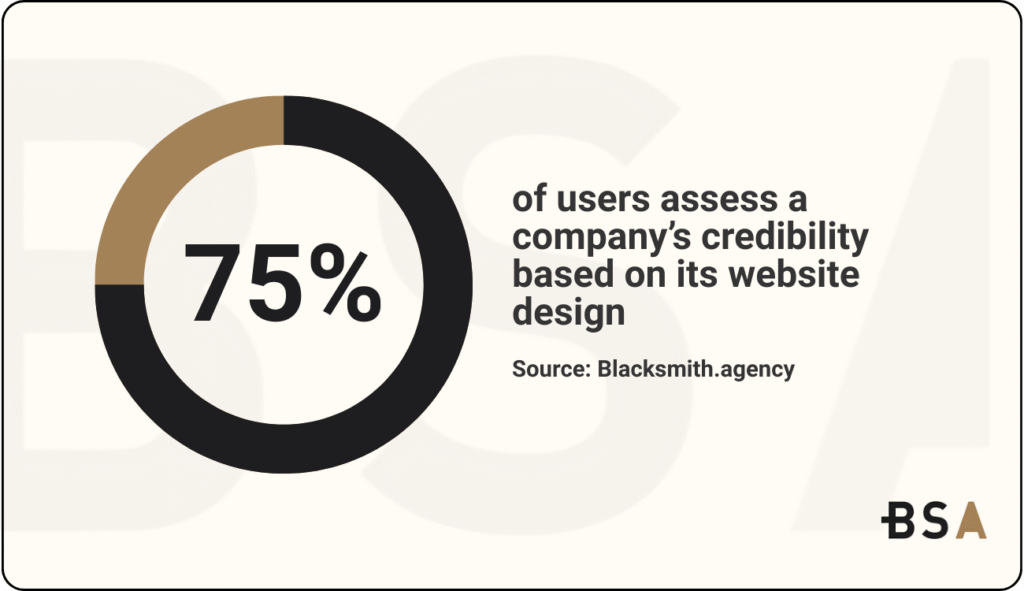
Did you know that 75% of users assess a company’s credibility based on its website design? To build said credibility, you need a website that is modern and up to date with the latest web development trends. But “trends” can be a fluff word nowadays. In 2026, the web development trends that truly matter are the ones that are meant to improve your overall website structure.
In this article, we’ll go over 15 of the biggest web development trends of 2026 that are shaping how modern websites look.
Trying to improve your web development strategy, but don’t know where to start? Let us help.
1. AI Becomes Part of the Delivery Pipeline
AI is no longer just used to autocomplete certain simple tasks. In 2026, AI is becoming increasingly prominent in entire workflows, from helping with test generation, documentation, code review suggestions, and even UX copy and accessibility checks.

The main shift came from teams no longer treating AI as optional but instead treating AI as any other production dependency.
What we suggest doing:
- Create a “definition of done” for AI-assisted code (review rules, security checks, testing requirements)
- Don’t ship generated code without license/security scanning from AI
- Use AI to generate tests and docs after architecture decisions are finalized (avoid letting AI decide your system design)
2. Server-First Rendering Moves From Niche to Default
One of the biggest web development trends of 2026 is the push toward doing more work on the server. Using less JavaScript and instead relying on smarter caching and streaming. This is not just about performance. It’s also about being able to reduce client complexity, improving security boundaries, and making data access less prone to errors.
It’s also a good reminder that new rendering models can introduce new security considerations, and you have to keep dependencies up to date while also understanding the threat models.
What we suggest:
- Split your UI into “interactive islands” rather than making everything client-side.
- Treat caching as a first-class API (design cache keys, invalidation, and revalidation deliberately)
- Validate assumptions with real-user monitoring (RUM) rather than a simple “it feels fast” comment from a local dev
3. Edge Computing Matures Into a Normal Deployment Target
In 2026, edge isn’t only for CDN caching. More teams run compute closer to users for latency-sensitive APIs, personalization, auth flows, and streaming SSR.
This trend pairs with server-first rendering specifically. Edge nodes can pre-render or authorize faster than a centralized region in most cases.
What we suggest to do:
- Decide which workloads belong at edge vs. region (authorization checks and lightweight personalization generally win, while DB transactions may not)
- Design for distributed constraints such as cold starts, limited runtime APIs, and data locality
- Use edge strategically for critical paths such as landing pages, pricing, and checkouts rather than forcing everything onto edge
4. TypeScript Becomes the Baseline, Not a Frontend Preference
A lot of teams have already “adopted” TypeScript. But the 2026 trend is treating type safety as a system design tool for the most part.
End-to-end typing (DB → API → UI) reduces regressions, makes refactors safer, and improves onboarding speed. This is increasingly framed as a default expectation in modern toolchains and frameworks.
What we suggest to do:
- Push types across boundaries: typed schemas, typed API clients, shared contracts
- Use types to encode invariants such as permissions, state machines, and form validation constraints
5. Web Platform Baseline Becomes How Teams Decide What Is Safe to Use
For years, frontend teams relied on fragmented signals from browser release notes, GitHub issues, and Stack Overflow threads to determine if a feature was ready to implement. That created hesitation and overreliance on heavy polyfills or framework abstractions.

In 2026, the industry increasingly aligns around the Web Platform Baseline as a formal compatibility signal. Baseline defines when a feature is consistently supported across modern browsers, eliminating guesswork and dramatically reducing the need for fallback code.
This matters a lot more than you might think. Generally, teams are either:
- Adopting new platform features for too long and stagnating
- Adopting features too early
When you standardize around Baseline, you often:
- You eliminate unnecessary transpilation for legacy browsers.
- You reduce dependency on framework-level shims
- You shrink JavaScript payload size
- You improve cold-start performance
- You simplify QA matrices
It also subtly shifts power back to the platform instead of frameworks.
What we suggest doing:
- Add a Baseline status to architecture review documentation.
- Update linting rules to discourage non-Baseline APIs unless justified
- Reduce Babel/polyfill footprint based on Baseline targets.
- Use progressive enhancement intentionally, not reactively.
This is all less about “new features” and more about building with long-term maintainability discipline.
6. WebGPU: The Browser Becomes a High-Performance Compute Surface
In 2026, WebGPU marks one of the most meaningful structural upgrades to the web platform in over a decade. Browsers are no longer limited to document rendering and lightweight interactivity. It now functions as a legitimate high-performance graphics and compute environment.
WebGPU replaces WebGL’s older model with a modern GPU interface that offers more low-level control, improved performance, and better memory management. But the real importance of WebGPU is not simply faster 3D graphics. It’s the expansion of what a browser is capable of handling by itself.
This unlocks real-time data visualization at scale, interactive scientific simulations, browser CAD tooling, advanced fintech dashboards, and certain forms of machine learning inference. It closes the gap between web and native desktop performance in ways that weren’t possible before.
WebGPU helps product teams create data-heavy SaaS platforms. It lets them render millions of data points easily. They can simulate environments right in the browser. Also, it enables fast, interactive experiences without relying on a remote server.
We recommend:
- Adopting WebGPU for high-impact rendering or compute bottlenecks, not general UI
- Maintaining progressive enhancement with fallback strategies where hardware support may vary
- Profile GPU memory consumption carefully before production rollout
- Invest in engineers who understand graphic pipelines and shader programming fundamentals
WebGPU is not a marketing feature. It’s an architectural capability.
7. WebAssembly as a Structural Performance Layer
WebAssembly has evolved from a novelty item to a strategic architectural layer. In 2026, WebAssembly is less about experimentation and more about targeted performance and portability.
Its main value lies in enabling near-native performance for compute-intensive modules while preserving sandboxed execution. It allows teams to run Rust, C++, Go, and other languages inside a browser environment without abandoning web distribution.
More importantly, WebAssembly excels mainly in performance-heavy tasks such as cryptographic operations, image and video processing, document parsing, data compression, and computational algorithms. It is not a replacement for JavaScript-based UI logic. Instead, it acts as a high-efficiency engine beneath it.
Teams that treat WebAssembly as a crucial tool for certain points will see strong gains. Teams trying to rewrite all applications in WebAssembly will find it adds extra complexity.
What we recommend:
- Use WebAssembly only where profiling identifies measurable bottlenecks
- Treat WebAssembly modules as versioned and testable contracts
- Maintain clear API boundaries between JS and WordAssembly layers
- Avoid unnecessary architectural sprawl by rewriting stable JavaScript components
8. HTTP/3 as a Real-World Performance Multiplier
While application-level optimization dominates most engineering discussions, transport-layer improvements often produce silent gains. HTTP/3, built on the QUIC protocol, has slowly shifted into a practical performance multiplier for many production environments.
HTTP/3 is different from earlier protocols. It cuts down on head-of-line blocking. Also, it works better when packets are lost. It works great in unstable network conditions. For example, it handles changes from cellular to Wi-Fi smoothly.
This is more important as global SaaS use grows. Mobile-first usage is also leading in many industries.
In 2026, enabling HTTPS/3 is not experimental. It is gradually setting the standard for infrastructure choices for teams using modern CDNs.
The impact is most noticeable in initial connection times and in environments with high latency. While HTTP/3 alone cannot fix a poor frontend architecture, it compounds gains from good caching and rendering discipline.
What we suggest:
- Ensure your CDN and hosting providers have HTTP/3 enabled
- Validate improvements using real user monitoring rather than lab assumptions
- Combine protocol upgrades with caching and asset optimization strategies
- Monitor handshake performance across regions to confirm measurable impact
Transport performance is rarely flashy, but it influences every single user request.
9. Passkeys and the Evolution of Identity Architecture
Passwords have long been a structural weakness in web architecture. They create friction for users and expose platforms to phishing, credential stuffing, and account takeover risks.
Passkeys represent a fundamental shift in identity assumptions. Instead of relying on other user-memorized secrets, passkeys use a device-bound cryptographic credential, often secured behind biometrics. This dramatically reduces phishing risk while also simplifying authentication experiences.
The importance of passkeys in 2026 is not theoretical. Major platforms increasingly support them as primary login mechanisms. As user expectations shift toward frictionless authentication, password-heavy flows begin to feel outdated.
However, passkeys do not eliminate all security risks. They change how they interact. This means that authentication design is no longer purely a backend engineering concern. It is a product-level decision that impacts onboarding speed, user trust, and support overhead.
What we recommend:
- Introduce passkeys as an opt-in upgrade path before making them default
- Design robust, abuse-resistant account recovery workflows
- Strengthen session management policies to complement passkey adoption
Identity architecture in 2026 prioritizes phishing resistance and user simplicity at the same time.
10. Privacy-Safe Measurement and the Post-Third-Party Cookie World
Even as timelines around third-party cookies have evolved, the direction of privacy enforcement is clear. Cross-site tracking is constrained. Data minimization expectations are rising.
This changes the economics of analytics and attribution.

In 2026, measurement strategies increasingly depend on first-party data collection, server-side processing, and privacy-aware architecture. Marketing performance is no longer separated from engineering implementation.
This shift also means that product teams must design a more transparent user consent experience and reduce the overcollection of unnecessary data.
What we suggest:
- Audit dependencies on third-party cookies and tracking scripts
- Move critical analytics events to server-side collection where feasible
- Implement consent-aware event gating
- Reduce unnecessary third-party scripts that degrade performance and privacy posture
Privacy-forward architecture is now a core part of brand credibility.
11. Accessibility Enforcement and WCAG 2.2 Adoption
Accessibility in 2026 is increasingly tied to legal, regulatory, and procurement realities. WCAG 2.2 expands guidance around focus visibility, interactive controls, drag-and-drop behavior, and target sizes. The European Accessibility Act adds compliance pressure in EU markets.
This means accessibility is no longer a “nice to have” option. It’s mandatory and a potential operational risk factor if not well implemented.
Engineering organizations must integrate accessibility into design systems and CI pipelines. The bigger benefit is that accessibility improvements often enhance overall usability.
Accessible maturity frequently correlates with engineering maturity.
We recommend:
- Integrating automated accessibility testing into CI workflows
- Embedding contrast and focus requirements directly into design tokens
- Conducting manual keyboard navigation audits during QA
- Documenting accessibility expectations in product requirements
12. Software Supply Chain Security and Dependency Governance
The npm ecosystem remains powerful and expansive, but it’s also vulnerable. In 2026, supply chain compromise remains one of the highest-leverage attack vectors in web development.
Modern applications often depend on hundreds of different packages, many of which include nested dependencies. A single compromised package can affect thousands of applications at once.
Security is no longer limited to your own codebase. It extends to every installed package.
What we suggest:
- Restrict dependency additions without architectural review
- Enforce lockfile integrity and version pinning
- Use automated security scanning tools regularly
Dependency hygiene is architectural hygiene
13. OWASP Top 10 and Secure-by-Default Design
The OWASP Top 10 is still a structural reference for common web application vulnerabilities. The 2025 update reinforces familiar but persistent risks such as broken access control, injection flaws, misconfigurations, and more.
Most severe breaches result from predictable failures. In 2026, secure-by-default design requires embedding guardrails directly into frameworks, templates, and component systems.
Security design is cheapest when applied at a system level, not a patch level.
We recommend:
- Map architecture to OWASP categories during design reviews
- Centralize access control logic
- Enforce consistent security headers across environments
- Integrate security testing into pull request workflows
14. Observability as Foundational Infrastructure
As architectures span client, edge, regional compute, and third-party APIs, debugging without structured observability becomes increasingly fragile.
OpenTelemetry adoption and tracing practices allow teams to instantly recognize and correlate frontend performance issues with backend bottlenecks. This changes guesswork into evidence-driven fixes.
In 2026, observability is not only about performance metrics, though. It’s also about tracking business logic, AI-assisted flows, conversion funnels, and system anomalies.
What we suggest:
- Standardize tracing schemas early
- Correlate frontend and backend traces
- Track business KPIs alongside technical metrics
- Monitor AI-generated flows separately for anomaly detection.
15. Continuous Performance Governance
Performance engineering in 2026 is all about ongoing governance, not a pre-launch checklist.
Modern performance discipline includes hydration strategy optimization, third-party script containment, streaming rendering, intelligent prefetching, and strict asset budgeting.
Core Web Vitals remain important, but teams expand beyond them into route-level budgets and regression enforcement in CI.
Organizations that treat performance as a shared responsibility across design, frontend, backend, and infrastructure will see sustainable improvements.
What we recommend:
- Set enforceable performance budgets
- Fail builds when regressions exceed thresholds
- Continuously audit third-party scripts
- Treat performance dashboards as operational tools, not vanity metrics.
Get a Custom Web Development Strategy That Converts With Blacksmith
After going through this list of the top 15 web development trends of 2026, it’s easy to see how much work it takes to fully implement some of these “trends” into your website and workflow. Some can take weeks and even months to properly implement. This is time you could be using on other aspects of your business. So what now?
That’s where we come in. Blacksmith is a Web Development Agency with a group of professional web developers ready to create and implement the ideal strategy for your business. From integrating the latest technologies to adding industry-specific features, we will ensure that your website performs its best.
Unsure if investing in a new web development strategy is what your brand needs to grow? Don’t worry, schedule a call with us, and we’ll provide you with a complete website audit. This way, we can show you the areas where a lack of an up-to-date website can make you lose potential clients in the long run.