



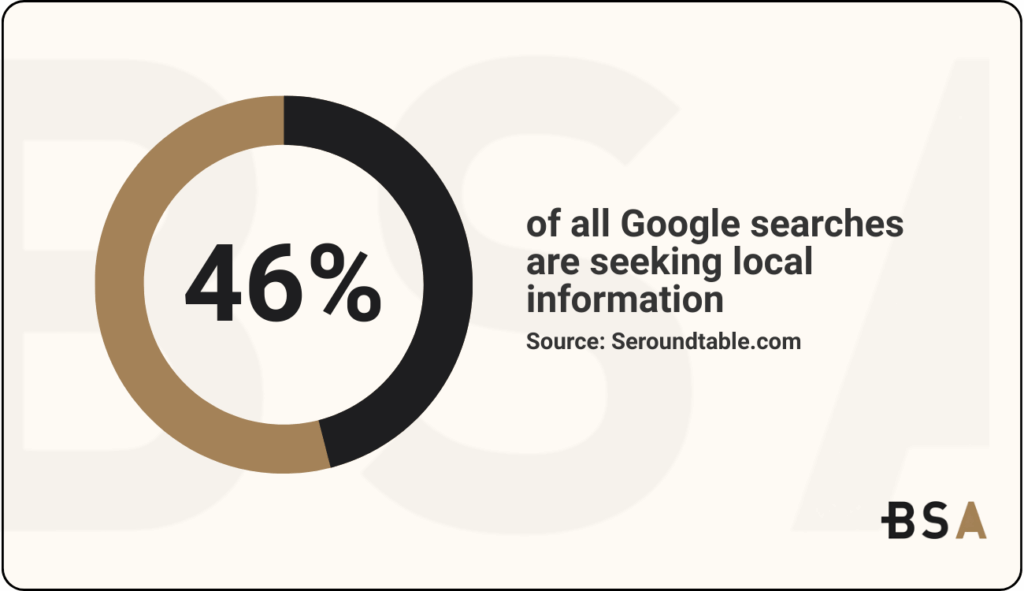
46% of all Google searches are seeking local information.
This means that knowing and applying good local SEO strategies is a must if you want to bring in as much traffic to your website as possible.
Local SEO strategies continue to evolve and in 2026 that is no exception.
For local businesses wanting to thrive online, they shouldn’t try to rely on tricks, hacks, or quick tactics.
Instead, they should focus on leveraging proven, long-lasting SEO strategies that stand on their own despite algorithm updates or changes to SEO.
This list of the top 30 local SEO strategies not only showcases which strategies work, but it also shows you how to quickly implement them so you can improve your local SEO immediately.
Trying to improve your SEO strategy but don’t know where to start? Let us help.
Our Top 30 Favorite Local SEO Strategies of 2026
This list is in no particular order.
We have tested and implemented all of these local SEO strategies on different websites and can certify that all them work amazingly for organic traffic generation.
1. Optimize your Google Business Profile
Your Google Business Profile is by far one of the most important aspects of a good local SEO strategy.
Your GBP is one of the first things a user looking for a product or service you offer will see. It directly affects your visibility, click-through rates, and even conversions at times.
A fully optimized GBP should include correct business information, updated hours, high-quality images, service details, and attributes.
Businesses that regularly update their profile gain stronger trust signals and overall better engagement.
Consistency is a must, which means that posting updates, replying to reviews, and maintaining accurate data should be part of your weekly plan.
2. NAP Consistency
Name, Address and Phone number (NAP) consistency is a vital part of local SEO strategies due to how search engines rank websites.
Search engines heavily rely on NAP signals to verify a business’s legitimacy. This means that any sort of inconsistency across directories, listings, or websites can create confusion and weaken your website’s authority.
Correcting outdated or mismatched listings should be a priority and will not only strengthen your local ranking potential but will also improve user trust.
In 2026, Google’s local algorithms remain highly sensitive to inconsistencies, making this a timeless optimization task.
3. Local Citations in Popular Directories
Local citations are a great local SEO strategy that will continue to help Google verify a business’s existence, importance, and actual location.
While mass citation building no longer provides as much value as it used to years ago, high-quality citations on popular listings are still a great way to improve your local SEO.
Platforms like Yelp, BBB, Apple Maps, Bing Places, and other industry-specific directories can reinforce your website’s credibility.
Accurate citations can also ensure that your business appears on every major search engine, which increases your overall local footprint.
4. Locally Optimized Content
Local content creation is still one of the best local SEO strategies to improve your organic search performance. Search engines will always favor businesses that show expertise in their niche and relevance in their geographic area.
This includes pages that talk about local issues, events, topics, and needs. Local landing pages, neighborhood guides, and localized blog posts establish an ever-deeper relevance.
The more context you provide about your connection to the area, the more signals Google has to rank your website and content higher in local search results.
5. Schema Markup for Businesses, Locations, and Services
Schema markup is not only an amazing way to improve your local SEO, but also a way to improve your SEO in general.
Structured data helps search engines understand your business information, categories, and offerings in a faster and more accurate manner.
Business schema, local business schema, review schema, and service-based schema all allow Google to showcase better results to users and improve overall visibility and click-through rates.
As search engines rely more and more on structured understanding, schema markups continue to offer a competitive advantage in local SEO.
6. Collect and Respond to Customer Reviews
Customer reviews are a great way to both improve your local SEO reach and your online reputation. Customer reviews can directly influence credibility, visibility, and conversion rates.
In 2026, reviews remain one of the biggest pieces of content that users want to read when searching for a product or service.
Responding to reviews, both good and bad, shows your brand’s commitment to customer satisfaction. Google uses all of this information and behavior as a signal of authenticity and can lead to better rankings, especially if most reviews are positive.
Businesses that get a consistent number of reviews will always outperform competitors who don’t have any sort of reputation-building strategy.
7. Optimize for Voice Search
Voice-enabled search continues to grow all over the world, and it is especially strong for local queries people search for, such as “restaurants near me” or “best electrician in my area.”
Voice search keywords are usually a lot longer than normal keywords, so creating a local SEO strategy that focuses on them is a must in 2026.
Optimizing for these long-tail keywords requires understanding natural language patterns, especially for your ideal customer.
Businesses that tailor content to reflect conversational search behavior gain major advantages in voice searches and AI assistant searches as well.
Learn how we increased bulb’s organic traffic by 45.7% with a new SEO strategy in our latest case study.
8. Improve Page Speed and Performance
Website load speed is still and will continue to be a determining ranking factor for every single website out there. Users in 2026 expect websites to load in less than three seconds and will leave if your website doesn’t meet these expectations.
As the time to load goes up, so do the bounce rate percentages, making website speed a priority.
Compressing images, minimizing scripts, implementing smart caching techniques, and using lightweight frameworks can completely revamp your website’s performance if done correctly.
While a faster website won’t just target your local SEO strategy and improve it, what it will do is improve your SEO rankings overall, which will also mean that your local SEO rankings go up as well.
9. Embed a Google Map on Your Contact Page
A Google Map embed improves your business’s local relevance and helps users instantly know where you’re located.
While it isn’t a major tracking factor, it does reinforce consistency across all of your channels and pages, which ensures a better overall user experience.
Search engines also use several contextual signals from your website to confirm your location.
This, of course, includes any map embed or plugin, driving directions, and neighborhood information provided. All of these help Google quickly know where your business is located, and it helps users figure out where to go.
Map embeds also build user confidence by showing that your business is easy to find, supporting both online visibility and real-world accessibility.
10. “Near Me” Search Optimization
“Near me” queries are still one of the most common ways for users to do any type of local search. This means that optimizing for them is a must and should not be skipped if you want to improve your local SEO strategies as a whole.
While Google derives “near me” results mainly based on proximity and relevance, it also understands the importance of localized terminology and local authority.
This means that working on your overall local authority and integrating localized terms into your website pages can lead to increased exposure when users are searching for businesses in your industry near them.
11. High-Quality Backlink Building from Local Sources
Local backlinks are an amazing way to improve your trust signals as a whole.
Links from newspaper websites, community blogs, local partners, and sponsorships can all reinforce your local authority.
Google’s search engine sees these links as proof of your real-world presence and reliability as a local brand. In 2026, all link-building strategies rooted in real community engagement will always outperform any type of artificial link acquisition. And don’t forget, local backlinks strengthen not only local presence but also overall organic rankings in the process.
12. Consistent Technical SEO Adjustments
Crawlability, indexation, site architecture, HTTPS security, and mobile usability will all impact your local rankings one way or another. Technical SEO ensures that search engines are able to access, interpret, and trust every piece of content on your website.
Normal issues such as broken links, excessive use of redirects, or unoptimized metadata can all suppress visibility if you’re not careful.
Maintaining your technical SEO practices is your responsibility every single month and not just a one-time activity.
In competitive local markets, strong technical SEO often determines whether a business ranks above or below similar competitors, especially for organic listings below the local pack.
13. Local Landing Pages for Every Main Service
Brands that have multiple services should consider creating dedicated pages for each main service they offer. These pages can strengthen relevance for each location and reduce competition between services with overlapping keywords.
Well-structured location pages should always include this:
- Local keywords
- Service descriptions
- Geographic markers
- Testimonials
- Unique content
When done correctly, these landing pages will improve both local rankings and conversions by a considerable amount compared to having them all in one place.
14. Proper Use of Internal Linking
Internal links help guide both users and search engines through all of your pages. They significantly improve crawl paths, improve overall authority, and signal to search engines that your website is relevant.
Internal linking will always be one of the local SEO strategies to be on top of if you want better rankings. Internal linking should always link to important pages on your website, such as service pages, local landing pages, and blog posts.
This strategy helps search engines understand how your website’s structure works and elevates the authority of your important location-specific pages.
A solid internal linking structure builds a strong foundation for organic visibility and ensures important pages are indexed and ranked effectively.
Explore how we increased Bonanno Concepts’ organic traffic by 648% with a brand-new SEO strategy in our most recent case study.
15. Stay Active on Your Google Business Profile
Google Business Profile posts might look meaningless, but they are an amazing engagement tool in 2026. Posting updates, offers, events, and announcements on your GBP signals that your website is active and relevant.
Google always favors and gives priority to GBPs that are active, high-quality, and have complete information.
Ultimately, posts support both brand visibility and user confidence.
While posts alone won’t magically improve your rankings, they will reinforce your overall authority, which contributes to improved visibility over time.
16. High-Quality Photos and Videos Across Listings
Visual content will always draw the attention of users and increase credibility as long as it’s done correctly.
High-quality photos and videos of your business, team, location, and services help users feel more confident about choosing your brand.

Images also heavily influence Google’s perception of quality and completeness.
This means that regularly uploading fresh visual content can quickly outperform stagnant profiles in both engagement and ranking momentum.
17. Optimize Both Title Tags and Meta Descriptions
Search engines rely on metadata to quickly interpret content. This means that optimizing both your title tags and meta descriptions with local keywords reinforces geographic relevance.
This means your keyword should relate to a geographical area, should have service modifiers, and intent-based local phrases.
Effective metadata improves your click-through rates and allows your pages to attract people who are genuinely interested in what your brand has to offer.
18. FAQ Pages with Local Questions
FAQ pages serve both users and search engines alike. They should address common concerns, reduce friction, and make it easier for potential customers to make a decision.
But from a local SEO standpoint, FAQ pages capture long-tail, intern-driven queries that competitors often overlook. These pages also enhance visibility in voice search and AI-derived result summaries.
19. Invest in Long-Form High-Quality Local Content
Long-form content builds authority, educates readers, and supports deeper SEO coverage.
Articles that explore local issues or topics related to your service demonstrate topical expertise.
High-quality content can also attract good backlinks, improve dwell time, and encourage users to come back for more information.
In 2026, content quality continues to be a core differentiator among local competitors.
20. On-Page Optimization for Each Service Page
Clear headings, structured content, optimized images, and targeted keywords all influence page-level performance.
Every single service page should be built around a primary topic and reinforced with local relevance.
On-page SEO remains a must for organic visibility. Well-optimized service pages will always outperform generic and short content in local search.
21. Avoid Duplicate Local Pages
Search engines devalue duplicate content and doorway-style pages. This means that businesses that are mass-producing generic or repetitive location pages might risk penalties or decline in ranking.
Unique content for each page makes for a far more interesting user experience and better relevance.
For 2026, your website should always prioritize quality over quantity. Fewer pages that are fully built and thought out will always outperform generic pages built with little to no thought in mind.
22. Update Old Pages and Content
Fresh content signals relevance to Google. Updating outdated information, refreshing data, and expanding old blog posts also helps maintain authority.
Google always rewards websites that show that their content is accurate, relevant, and has good engagement.
Refreshing old blog posts and content in general is generally more valuable than creating content from scratch, especially when those blog posts are getting traction already.
23. Mobile-First Usability
With mobile searches dominating local searches by a wide margin, mobile optimization has never been more important.
Simple navigation, fast load times, easy-to-read text, and touch-friendly elements are all must-haves that your mobile website should not skip out on.
User frustration on mobile websites will directly affect dwell time and bounce rates, and Google will instantly reflect this negative behavior in rankings.
An exceptional mobile experience is a baseline requirement for good local SEO strategies.
24. Localized Keyword Within Content
Keyword stuffing is outdated and harmful SEO-wise, but the natural use of local terms remains as relevant as ever.
This includes using neighborhoods, cities, landmarks, and colloquial terms that users generally search for.
Content that reflects real local understanding will always be relevant and credible.
In 2026, search engines are mainly prioritizing authenticity in local keyword usage. This means that properly doing your research and adding local knowledge to your content are important.
25. Build Trust Signals for Local Credibility
Trust signals such as badges, awards, associations, or third-party endorsements all help users choose your business over competitors.
These visual cues can all improve the perception of your brand to users and can reduce overall friction during their decision-making process.
Search engines will also consider user trust as a determining factor when it comes to overall rankings for both local SEO and general SEO.
26. Earn Snippets for Local Queries
Featured snippets, local Q&A results, and AI-overview citations will always influence your website’s visibility.
Answering as many questions as possible and structuring content clearly increases your chances of earning these placements.
Snippets attract high-intent traffic and position your brand’s website as an authoritative resource, which in turn improves your overall ranking.
27. Strengthen Engagement Metrics Through a Better UX
Local SEO performance correlates with an exceptional user experience.
Time on page, engagement, and low bounce rates signal to search engines that the website is high-quality and relevant.
Improving your UX through a cleaner design, an intuitive layout, and well-organized content all strengthens these signals and contributes to higher rankings over time.
28. Use Social Media as a Local Visibility Amplifier
While social media doesn’t directly boost your local SEO rankings, it supports brand visibility, reputation, and engagement.
Sharing local content, being active on different social media apps, participating in conversations, and staying active help users discover and trust your business.
These social signals reinforce your brand’s authority in the community you’re in and can improve your local SEO success.
29. Monitor Competitors Regularly
Staying on top of competitive analysis remains a great strategy in 2026.
Reviewing competitor listings, websites, reviews, and content can help you pinpoint where your website needs to improve.
By being able to identify gaps and build upon them, you will be able to outperform competitors in areas they might not care too much about. This helps you gain traction in rankings and user preference.
30. Track Local SEO Performance and Adjust Accordingly
Local SEO is ongoing and ever-evolving. Tracking keyword rankings, map performance, traffic sources, engagement, and behavior trends allows you to refine your strategy.
Businesses that continuously adjust to user behavior, algorithm changes, and competitive shifts will always perform better for long-term results.
Get a Custom Local SEO Strategy That Converts with Blacksmith
After going through this list of the top 30 local SEO strategies, it’s noticeable how many different strategies you need to factor in if you want to improve your local rankings consistently.
This is without even considering the constant maintenance you’ll need for both your overall SEO strategy as well as your local SEO strategy.
And let’s face it, creating a completely new SEO strategy from scratch can take weeks to months depending on how thorough and complex the strategy is.
This is time you could be using on other aspects of your business, so what now?
That’s where we come in. Blacksmith is a professional local SEO agency with a group of professional digital marketers ready to create the perfect local SEO strategy for your business.
From adding all of these points in the article to adding niche-specific strategies, we will ensure your website has the visibility and conversion it deserves.
Still unsure if investing in a local SEO strategy is a good decision for your brand?
Don’t worry, click here to schedule a call with us and we’ll provide you with a complete website audit. This way, we can show you the areas where your website lacks proper SEO and what we can do to improve it.