


Incorporating trust signals into your website solves a critical problem: 77% of website visitors worry that their data could be stolen and misused. Worse yet, 19% abandon their carts because of payment security concerns.
Trust indicators like security badges, customer reviews, and professional certifications reassure visitors that your site is legitimate. This guide will show you how to build trust signals by placing the right ones throughout your pages.
Ready to turn skeptical visitors into confident customers? Let’s get started.
What Are Trust Signals and Why Do They Matter?
These visual and textual elements reassure people that you deliver on your promises and operate as a legitimate company.
The concept of trust signals emerged in the March 2000 edition of the Journal of Computer-Mediated Communication. Researchers described how trust badges or seals from organizations such as the Better Business Bureau and TrustArc appear on e-commerce websites.
Consumers were skeptical about providing credit card information online at that time. Trust signals helped them overcome those fears.
Trust indicators fall into three major categories. The first type encourages visitors to complete a purchase or take action on your site. Another exists elsewhere online and drives visitors to your website. Finally, some consist of signals that visitors might not notice but that search engines use for ranking.
Common examples include SSL certificates, customer reviews, detailed case studies, security badges, industry certifications, awards, media mentions, and compliance indicators.
Trust signals can be explicit, like customer testimonials or security seals, or implicit, such as clean interface design, fast load time,s and user-friendly navigation.
The Psychology Behind Visitor Trust
Your brain makes rapid judgments about website credibility. Research from Stanford University shows users form a first impression in 10 to 20 seconds, whereas some studies suggest initial aesthetic judgments happen in just 50 milliseconds. These snap decisions rely on what psychologists call System 1 thinking: the brain’s fast, automatic, and emotional processing system.
A 2018 Harvard Business Review study revealed that online consumers rely more on intuition than on logic and rule-based processes for risky decisions. Visitors won’t engage with your brand, regardless of your offer, if your site doesn’t feel authentic or trustworthy.
Design elements accounted for more than 94% of the reasons users cited for mistrusting a website, which were related to design elements, such as jarring pop-up ads, cluttered layouts, or an unprofessional aesthetic. This creates a hierarchy: visual design affects trust more than content itself during the initial visit.
The core mechanism driving this phenomenon is processing fluency. This refers to the cognitive ease with which a user can process and understand information. A website with a clean layout, clear visual hierarchy, and logical structure creates positive cognitive states. Your brain interprets this ease as familiarity, truth, and safety.
A neuroimaging study published in the Journal of Interactive Marketing observed 29 subjects during a simulated online purchase. The analysis revealed that seals of approval from third-party organizations were most trusted, whereas rating systems were less trusted because they provoked feelings of uncertainty and risk.
Build Trust Signals to Affect Conversions
The relationship between user trust in website design and conversion rates is significant. This substantial link suggests that enhancing elements that build trust within your website’s design affects over half of your customers’ decision-making process.
Research on website trustworthiness and usability found that these factors are linked closely. The easier your website is to use, the more visitors are likely to trust your company and complete a purchase.
When you build trust signals, you reduce the perceived risk at critical points in the buyer’s trip. Pages like product pages, pricing pages, and checkout pages aren’t just informational.
These pages are where users decide whether to act. Doubts or friction kill conversion left unattended. Trust signals act as reassurance exactly where you need them.
Authentic reviews and social proof don’t just help immediate conversions. They improve search presence, foster repeat business, and enhance overall brand credibility.
When you feature testimonials on your website to demonstrate positive work you’ve accomplished in the past, visitors see your track record and are more likely to trust that you’ll provide them with a similarly excellent experience.
Essential Security and Privacy Trust Signals
An SSL certificate authenticates your website’s identity and makes encrypted connections possible between your web server and visitors’ browsers. SSL stands for Secure Sockets Layer, a security protocol that creates an encrypted link protecting data transmission.
A padlock icon next to the URL in the address bar shows that SSL protects that website. The acronym HTTPS (HyperText Transfer Protocol Secure) appears in the URL when a site has an SSL certificate installed. Only HTTP appears without one, missing the S for Secure.
You can view certificate details by clicking the padlock symbol in the browser bar. Details typically have the domain name, the person or organization it was issued to, which Certificate Authority issued it, the Authority’s digital signature, associated subdomains, and issuance and expiration dates.
Three certificate types exist. The organization’s name appears in the address bar for an EV (Extended Validation) SSL. You see the organization’s name by clicking the padlock icon for an OV (Organization Validated) SSL. Only the padlock icon is visible for a DV (Domain Validated) SSL.
Google and other search engines prioritize security and rank websites with SSL certificates higher. Most browsers tag HTTP sites as ‘not secure’, signaling that the site may be untrustworthy. This warning can cause visitors to leave your site quickly, increasing bounce rates and lowering search rankings.
Security Badges and Seals
Site seals, also known as trust marks, are images you can place on your website to convey that the site is secure. These marks display the logo of the trust authority that provides security validation.
Certificate Authorities provide site seals as security badges you can add to your website to prove your encryption and brand security.
A Baymard study of 2,520 responses found that recognition matters more than technical security when users assess trust seals. Norton, Verisign, and McAfee ranked highest not because of superior security features but because users recognized these brands from their antivirus software.
Payment Provider Logos
Displaying payment method logos like PayPal or Visa helps customers feel secure when making purchases. These logos inform visitors about available payment options and signal that your store has met the requirements to use those payment types.
Customers feel more confident and secure when they see familiar payment icons, which can boost conversion rates significantly. Payment logos reduce hesitation and encourage faster purchases.
Privacy Policy and Data Protection Notices
Privacy policies are required by law worldwide if you collect data that can identify an individual. This data includes email addresses, names, shipping addresses, and social security numbers.
Your privacy policy must disclose material data practices and how data is collected, used, and shared. The FTC Act prohibits unfair and deceptive trade practices and makes inaccurate or incomplete privacy notices a legal liability. You should review and update your privacy policy annually or with any change in business practices.
Building Credibility Through Social Proof
Social proof changes how visitors see your business. Nearly 90% of consumers read online reviews before purchasing, so your credibility depends on showcasing authentic customer experiences across multiple formats.
Customer Reviews and Ratings
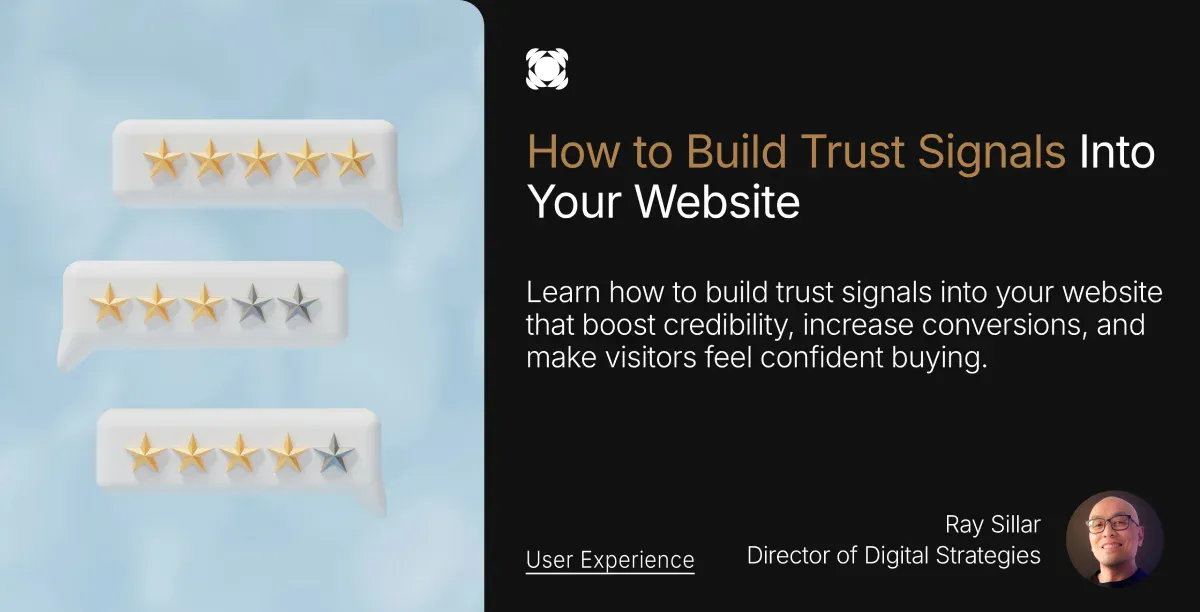
Authenticity matters more than perfection. Consumers read an average of 10 reviews before forming an opinion, and 98% read them before making a purchase. Balanced ratings that include negative feedback boost credibility since flawless ratings raise suspicions.
Verified buyer badges boost trust. Reviews from verified purchasers improve purchase odds by 15% compared to anonymous sources. FTC regulations effective October 21, 2024, prohibit buying positive reviews or implying that reviews must be positive to receive incentives. Online reviews reduce product returns by 20% according to BazaarVoice data.
Video and Written Testimonials
Video testimonials create emotional connections that written content cannot match. People retain about 80% of visual information compared to only 20% of text-based information. 79% of people prefer video testimonials to learn more about a company or product.
Strategically placed written testimonials remain powerful. Your website, business proposals, and office waiting areas all benefit from client feedback. Ask for testimonials when clients express satisfaction, not just at project completion.
User-Generated Content Galleries
User-generated content (UGC) outperforms branded messages. Over 54% of marketers believe UGC is the most engaging type of social content. 9 out of 10 consumers trust peer reviews more than branded messages.
UGC galleries showcase real customers using your products in authentic contexts. Product-specific galleries work better than generic brand collections to avoid decision fatigue.
Client Logos and Case Studies
Case studies demonstrate your ability to handle complex projects and deliver measurable results. Testimonials highlighting recognizable clients establish credibility and prove enterprise readiness. Detailed accounts showcase problem-solving skills better than brief reviews.
Media Mentions and Press Features
Press coverage carries weight that paid advertising cannot replicate. Editorial content is more persuasive than advertisements since journalists provide unbiased coverage. A feature in a reputable publication serves as independent validation of your company’s relevance and newsworthiness.
Media mentions function as reusable assets across email footers, landing pages, social profiles, and sales presentations. Coverage that links to real published articles offers verifiable proof that reviews and testimonials cannot match.
Professional Trust Indicators For Your Website
Professional credentials separate legitimate businesses from questionable operators. Display industry-specific certifications on your website to signal expertise that goes beyond self-promotion.
Industry Certifications and Awards
Third-party credentials carry more weight than self-declared competence. For instance, web design certifications from recognized organizations like Google, Adobe, and industry associations demonstrate mastery of specific skills and platforms.
Your homepage should feature these credentials up front, though a dedicated awards page provides deeper context about what each recognition means.
Awards endorsed by respected industry organizations or leading trade publications provide instant credibility. Before you pursue any award, research past winners to verify that the honor carries genuine prestige rather than pay-to-play recognition.
Display award logos on your homepage and relevant product pages where they reinforce purchasing confidence.
Clear Contact Information and Support Options
Your Contact Us page ranks among the most visited sections of your site. Include a main phone number, customer service number if applicable, email address, and physical headquarters address with complete state and ZIP code at a minimum. Provide hours of operation and time zones for each contact method.
Phone numbers that connect to trained staff build more trust than contact forms alone. Users prefer talking to real people over email or chat for complex questions. Organize multiple phone numbers into labeled groups so visitors can identify the right department quickly.
Money-Back Guarantees and Return Policies
Money-back guarantees reduce perceived risk and make purchasing decisions easier. Recent research shows 82% of shoppers consider free or easy returns a major factor in buying decisions, and 76% prefer retailers that provide instant refunds or exchanges.
Your policy should specify eligible items, return timeframes (30, 60, or 90 days), condition requirements, and whether you offer full refunds, store credit, or exchanges. Display this policy on product pages and at checkout to reduce cart abandonment.
About Us Page with Team Information
Your About Us page introduces your identity, your mission, and your value proposition. Include team photos that feature names, roles, and brief professional biographies to humanize your business.
Around 85% of consumers trust online reviews as much as personal recommendations, which makes customer testimonials on your website valuable additions.
How to Implement Trust Signals Effectively
Placement determines whether trust signals work or get ignored. A 2018 study examining blockchain trust signals used a between-groups experiment to determine relationships among variables through manipulation and controls. The same rigorous approach applies to your website: you must test where signals appear and measure their effectiveness.
Strategic Placement on Your Website
Start by auditing your pages to identify where visitors express hesitation. Map your highest-traffic pages and those with high drop-off rates in conversion funnels such as pricing pages, product pages, and checkout. For each page, note where users hesitate or abandon their journey. These moments reveal trust deficits you must address.
Place trust elements where users need reassurance most. Above-the-fold placement catches attention immediately: star ratings, brief testimonials, security badges, or partner logos should appear near or above your call-to-action buttons. First impressions count, and having trust cues near the action increases confidence at the moment users consider taking the next step.
Your company’s website serves as a powerful tool for timely communication with varied stakeholders since it often provides the first source of information about your company. Consider adding videos or video transcripts with leadership discussing their role or areas of focus.
These elements promote transparency and create personal connections with stakeholders.
Avoiding Common Mistakes
Overcrowding pages with badges and seals creates the opposite of the intended effect. When you build trust signals, make sure your site doesn’t look spammy. Visitors may question why you need to try so hard to prove legitimacy.
Fake or vague testimonials destroy credibility faster than having none at all. Anonymous users, generic statements with no names or testimonials that sound too polished, raise suspicions.
Outdated reviews or ratings signal neglect. If your oldest displayed review is from 2018, visitors wonder if your business is still active or serves customers well. Keep review displays updated. An active, maintained presence reassures visitors that you remain engaged with customers.
Hiding policies, guarantees, or refund information in tiny text or hard-to-find pages undermines trust. Users interpret this as an attempt to obscure important details. Link to these documents and highlight key terms at the point of purchase.
Broken trust badges or expired SSL certificates scream negligence. These should be easy errors to spot and fix, so outdated badges tell visitors you don’t pay attention to important details. Check your security certificates regularly and ensure third-party badges link to valid, current verifications.
Testing and Measuring Impact
Trust signals require continuous tracking and testing to ensure actual performance improvement. Compare versions of landing, pricing, or product pages with different trust signals using no, minimal, or enhanced approaches. Track conversion rates, bounce rates, and cart abandonment at pages before versus after adding signals.
Heatmaps and user behavior analytics reveal whether people hover over guarantees, read reviews, or spend more time when trust signals display.
Tools like heat maps give you insight into where users linger on your pages and what elements they scroll past quickly. This visual data shows which signals capture attention and which get ignored.
A/B testing puts similar signals head-to-head. Create tests with different trust badges and arrangements to see which performs best. n.
Maintaining Authenticity and Transparency
Transparency builds trust through clear communication and honest representation. When your website accurately represents your business using authentic visuals or honest reviews, visitors feel comfortable interacting with you. Misleading or unclear information leads to poor customer experiences.
Clear communication requires honesty about what you offer. Describing products, services, or capabilities straightforwardly sets correct expectations and ensures you attract customers who genuinely appreciate what you do. Making things sound better than reality often backfires.
Making contact information accessible demonstrates openness. Visitors should never hunt for ways to reach you. Phone numbers, email addresses, and physical locations belong front and center. This transparency shows you are available and easy to reach.
Get Your Reputation Managed With Blacksmith
After going through this article, you might have noticed that building trust signals isn’t a one-time thing. They are constantly changing, and managing them properly can be the difference between people buying confidently and leaving at the first review they read.
But we’ll be honest, managing trust signals, especially your online reviews, is time-consuming. This is time better spent on other aspects of your business. So now what?
That’s where we come in. Blacksmith is an Online Reputation Management Agency with a group of digital marketers ready to manage and strategize your online presence year-round.
Still unsure if investing in a reputation management service is what your business needs? Don’t worry. Schedule a call with us, and we’ll provide you with a complete website audit. This way, we can show you the areas where poor reputation management is hurting your business more than you realize.