



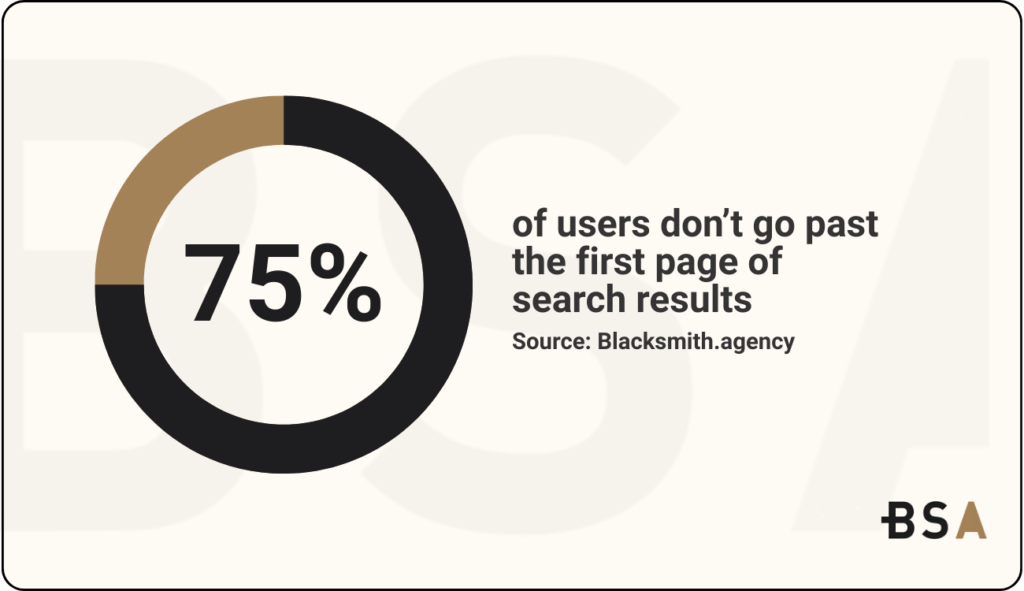
Did you know that 75% of users don’t go past the first page of search results? This means that not being on the first page of search results is a massive decrease in visibility. But don’t worry, in 2026, successful hotel SEO strategies are no longer basic fixes that don’t do anything meaningful.
Instead, they are about intent alignment, local relevance, technical performance, and building trust. Hotels that focus on the fundamentals of SEO will continue to gain visibility and traffic regardless of how many “trends” and changes come their way.
This article will provide you with 13 hotel SEO strategies we’ve personally tested and curated while working with clients. All of these strategies are actionable, effective, and function no matter the size of the hotel.
Trying to improve your SEO strategy, but don’t know where to start? Let us help.
Why Hotel SEO Strategies Matter
Even with new changes like AI and more booking platforms, search engines remain the main way users find hotels worldwide. Travelers search with intent. They often ask specific questions about location, dates, or experiences.
If a hotel appears organically for them when they search, it can potentially be the main reason why they pick it over anything else.
Well-executed hotel SEO strategies give you control over how your hotel is positioned online. Hotels can do more than just compete on prices in an OTA ecosystem. They can shift brand perception, highlight what makes them unique, and steer users toward making a booking.
1. Search Intent as the Foundation of All Hotel SEO Strategies
All good hotel SEO strategies start with understanding search intent. Years ago, tanking for high-volume keywords was more than enough. But now, relevance matters a lot more than reach.
Search engines now understand whether a traveler is researching, comparing, or is ready to book a hotel. A hotel that directly adjusts and tweaks its pages with those motivations in mind performs a lot better than one trying to work on everything.
Local searches, such as those mentioning neighborhoods, landmarks, or travel purposes, tend to be the ones that convert the most. Informational content is still essential for hotels, but it should support decision-making instead of being created with no real purpose in mind.
Hotels that build their keyword strategy around intent can create clearer page focus. This leads to stronger rankings and more meaningful traffic.
2. Location Optimization That Reflects How Travelers Search
Location-based optimization remains one of the most effective hotel SEO strategies. Travelers rarely search only by city name; they search based on how close things are to what they are in town for.
Hotels that create dedicated, well-written pages for these locations gain a clear advantage. These pages all signal relevance to search engines while helping travelers know if the hotel meets what they’re looking for.
A key tip you should consider is avoiding duplication of content. We mean making several pages with similar content. We just change some words, like the city, the landmark, or the nearby airport.
This severely hurts your SEO and should be avoided at all costs.
When properly done, location optimization can be one of the highest-ROI hotel SEO strategies available.
3. Local Visibility Through Google Business Profile Optimization
Google Business Profile optimization continues to be central to hotel SEO strategies. For many users, the local map results are more influential than any traditional organic listings, especially when on mobile devices.
An optimized profile ensures that a hotel appears accurately and competitively when travelers search nearby. Always include consistent contact info. Choose the right categories. Upload high-quality images. Also, respond actively to reviews.
Hotels that improve their Google Business Profile see better results. They know it’s a living asset, not just a static listing. After a few months, these hotels often lead in local search results.
4. Reviews as a Ranking and Conversion Signal
Guest reviews have become deeply intertwined with hotel SEO strategies. They influence visibility, click-through rates, and booking decisions, all at the same time.
Search engines analyze review volume, freshness, sentiment, and even response behavior. Real reviews tell the search engine that the hotel is active and trusted. Thoughtful responses show engagement and professionalism.
Hotels that integrate reviews and management into their SEO strategy benefit from both improved rankings and a higher conversion rate.
5. Mobile Performance as a Competitive Advantage
Mobile performance is no longer optional and easy to ignore. Mobile is now a core aspect of all hotel SEO strategies. Search engines now evaluate hotel websites primarily through a mobile-first lens. The mobile version of your hotel website is key for indexing, ranking, and user experience.
If your hotel’s mobile website loads slowly, shifts while loading, or looks confusing, it can turn off users and search engines. Effective hotel SEO strategies address this by focusing on the main pain points mobile websites usually have.

Image-heavy hotel sites should consider using modern image formats such as WebP and deferring non-essential media. Check booking engines from third-party providers closely. Make sure they don’t block rendering or add too many scripts that slow down performance.
Hotels that prioritize mobile performance will improve their rankings. They’ll also see better engagement metrics, such as time on site, bounce rates, and completed bookings. In this sense, mobile optimization is one of the rare hotel SEO strategies that improves every stage of the funnel simultaneously.
6. Content That Actively Supports Booking Decisions
Content remains central to hotel SEO strategies, but its role has changed a bit over the years. Publishing content solely to target keywords is no longer enough. Search engines are now focusing on whether content truly helps users make choices. This is especially important in areas like hospitality.
Great hotel content understands travelers’ questions and answers them clearly and confidently. This covers differences in room types, amenities, and experiences. It also sets expectations for the location and nearby attractions.
When your content removes uncertainty, it instantly increases trust, which in turn drives conversions.
In 2026, hotel SEO strategies favor depth over anything. A single, well-developed and thought-out page explaining a hotel’s business traveler offerings can outperform dozens of generic blog posts. Similarly, content that talks about seasonal conditions and travel purpose performs better than content that tries to speak to everyone at all times.
Search engines reward this because it directly aligns with intent. Travelers reward it because it can save them a lot of time. The result is content that ranks well, engages with users, and supports direct bookings.
7. Structured Data as a Visibility Multiplier
Structured data evolved into a powerful component of modern hotel SEO strategies. While schema markup does not guarantee rankings, it can directly improve how search engines interpret hotel information.
Hotels that use structured data help search engines grasp their property details. This includes services, reviews, pricing, and location context. This clarity reduces ambiguity and increases the likelihood of enhanced search results.
As search engines continue to add AI summaries and entity-based understanding, structured data will become more and more relevant. If you want to stay ahead of the curve, make sure to treat schema as a foundational piece in your hotel SEO strategies.
Explore how we increased Bonanno Concepts’ organic traffic by 648% with a brand new SEO strategy in our latest case study
8. Internal Linking as a Conversion Pathway
Internal linking is often discussed in technical SEO terms, but its real power in hotel SEO strategies is in guiding users through their decision-making journey. Every single internal link represents an opportunity to move a traveler closer to booking.
When blog content links naturally to room pages, when location pages connect properly to booking options, and when amenity pages reinforce value propositions, users experience the site as intuitive and useful.
All search engines view structure as a signal of topical authority and logical hierarchy. Poor internal linking, by contrast, leaves both users and crawlers guessing which pages matter most. Effective hotel SEO strategies focus on designing internal links that reinforce priorities, improve authority, and support conversion goals.
9. Visual Optimization as an SEO and Trust Signal
A hotel’s main goal is to sell experiences, and these experiences are mainly visual. This means that visual optimization is pretty much tied to effective hotel SEO strategies.
High-quality images influence how users perceive a property before they read a single word of copy. At the same time, search engines evaluate images for relevance, accessibility, and performance.
Poorly optimized images will slow down pages, worsen mobile pages, and reduce search visibility, for example.
Effective hotel SEO strategies make sure images are the right size, compressed, and have clear alt text. This text should explain the content instead of just stuffing in keywords.

Beyond rankings, visuals play a massive role in trust. Clear, real images of rooms, amenities, and surroundings help reduce uncertainty. This boosts booking confidence. When visual SEO is worked on properly, it enhances both visibility and conversion without compromising aesthetics.
10. Using Hotel SEO Strategies to Reduce OTA Dependence
One of the most strategic reasons why hotels end up investing in SEO is to regain control from online travel agencies. OTAs now dominate late-stage booking behavior, but hotel SEO strategies can allow you to influence travelers earlier in the journey.
Ranking for non-branded, intern-driven searches helps hotels get noticed by travelers early. This happens before travelers start comparing prices across different platforms. Branded SEO helps by directing travelers searching for a specific hotel straight to the hotel’s site. This means they avoid third-party sites.
Over time, strong hotel SEO strategies shift the balance of power. Hotels gain leverage, protect margins, and reinforce their own booking incentives without having to rely on paid media for it.
This long-term impact is one of the main reasons why SEO remains one of the most valuable investments in hospitality marketing.
11. Long-Tail and Conversational Search Optimization
Search behavior has become more conversational, more specific, and more reflective of real-world needs. Travelers increasingly use detailed phrases that describe exact preferences, such as quiet locations, parking, or proximity to specific venues.
Hotel SEO strategies embrace this shift by writing in natural language and structuring content to answer specific questions. This approach also focuses on both voice search and AI-assisted discovery, where clarity and context matter a lot more than exact keyword matches. Hotels that adapt their content to conversational search patterns position themselves for the future while also improving their current relevance.
12. Continuous Technical SEO Maintenance
Technical SEO is the backbone that supports all other hotel SEO strategies. Without it, the content quality won’t matter.
Hotel websites often accumulate technical issues over time due to CMS updates, booking plugins, conflicts, or legacy URL structures. These issues can create crawl inefficiencies, duplicate content, or indexing problems that quietly lower visibility.
Ongoing technical maintenance ensures that search engines can access, understand, and rank content as intended. This includes monitoring crawl reports, ensuring no duplication, managing redirects, and maintaining a clean site architecture.
13. Measuring Hotel Strategies by Business Impact
The best hotel SEO strategies are evaluated by their impact on revenue, not just on rankings. Higher visibility means nothing if it doesn’t lead to bookings.
Hotels that align SEO measurement with business outcomes gain a better insight into what truly drives growth. This includes understanding how organic traffic contributes to direct bookings, how SEO supports assisted conversions, and how different content types influence traveler behavior.

By measuring performance mainly by focusing on revenue, hotel SEO strategies can evolve from mainly being a tactical change for more views to a tactical and well-thought-out strategy. This lets marketing teams allocate resources efficiently and showcase the true value of SEO within the organization.
Get a Custom Hotel SEO Strategy That Converts With Blacksmith
After going through this list of hotel SEO strategies, you might have noticed that most, if not all, of these strategies take time to execute properly. The reality is that applying these strategies properly can take weeks or even months before you see a visible improvement. This is time you could be using on other aspects of your hotel business. So now what?
That’s where we come in. Blacksmith is a Hotel SEO Company with a group of SEO professionals ready to improve your hotel’s visibility and conversions with a custom SEO strategy.
Still unsure if a new SEO strategy is what your business needs? Don’t worry, schedule a call with us, and we’ll provide you with a brand and website audit. This way, we can show you the areas where a lack of an SEO strategy might be hurting your business and what we can do to fix it.