


Every day, in offices across the United States, business owners and marketing executives face a dilemma. The reason? An inability to decide what kind of website to invest in to be able to compete favorably with their competitors.
We see it all the time. The pressure is great because the stakes have never been higher.
In 2026, your website may very well be the only interaction a prospect has with your firm before deciding whether to book your service or opt for a competitor.
Despite this criticality, the choice between custom vs. template websites remains a source of boardroom friction. The fact is, website templates are excellent in their own regard in much the same way that custom websites are absolute essentials for others.
The friction arises when a growing company needs a custom solution but opts for a template to save funds, or when an early-stage startup over-invests in a custom design before finding product-market fit.
This article will help you smooth out that friction so you can decide which is best between a custom vs. template website.
See how our custom web design increased page views by 128.5%
Factors to Consider When Choosing Between Custom vs. Template Websites
The right decision boils down to 5 strategic factors. By analyzing each of these, you can determine which web infrastructure matches your current ambition and resources. What are these factors to pay attention to when choosing between custom vs. template websites?
1. Budget

Your website is perhaps your brand’s most important asset. It works for you 24 hours a day, 7 days a week. Given its importance to your sales and growth, it is not the place to cut corners on budget if you want to get the best.
However, we must be realistic. High-quality websites are costly. To decide what you can afford between a custom and a template website, you need to look at your current stage of business.
When to Choose a Template Design (Budget under $20,000)
If your budget is less than $20,000, a template-based website may very well be your best choice.
Templates allow you to select an existing web design style that is to your taste instead of hiring a team to create one. As such, you save the cost of hiring architects, designers, and engineers to build your vision from scratch.
For local small businesses, freelancers, solo consultants, or startups, this is a wise financial decision. However, the savings come at a cost.
There are a thousand other businesses like yours that have access to those same templates, including your competitors. By choosing a template-design, you lose ownership and uniqueness.
Again, while a template-design might be cheap in the immediate, the Total Cost of Ownership will continue to increase with time. Think about it. You will pay to fix broken plugins. You will pay to patch security breaches. You will lose money when leads leave your slow site. Over 36 months, the money you spend on a template design may become equivalent to your initial spend on a custom design or even surpass it.
In the end, a cheap template often costs more than a custom build over a long period of time.
When to Choose The Custom Option (Budget over $30,000)
If your business has steady revenue and is even looking to scale, a custom website may be the better choice.
With a custom design, you can build features that match your exact sales process, rather than forcing your process to fit into a pre-made box. While it often requires a higher upfront cost, it provides a foundation that lasts for years.
How do you know if you are ready to make the leap from template to custom? Well, you just have to look at your revenue.
Generally, 5-20% of annual revenue is recommended as an ideal marketing budget for growing businesses. Out of that marketing budget, we recommend you take at least 20% fto ensure your website is in shape. Ideally, this means that a healthy, growing business should invest roughly 1% of its annual gross revenue into its website infrastructure to ensure it can keep up with its operations.
Here is what that may look like, for example
- If your annual revenue is $3 million, spending $30,000 on a custom website is only 1% of your revenue.
- If your annual revenue is $10 million, spending $50,000 on a custom website is only 0.5% of your revenue.
For a mid-sized company making over $3 million, there is no financial reason to skip a custom build. This is especially true since the website will become a cornerstone of your marketing for another 3–5 years. The return on investment (ROI) beats the initial savings of a template.
2. Time Constraint
The other unavoidable reality about custom websites is that they take time to design and build. This is often a friction point for executives who want to react quickly to a market shift and desire quick results.
How Long Does It Take to Build a Custom Website?
A quality custom website typically requires 6 to 12 weeks for a small business website and up to 40 weeks for an enterprise website before launch. The exact duration depends on its size and the complexity of its features.
Why does it take this long? Because you are not just deploying a site, you are building a product. There is no way to fast-track this process because there are simply too many interdependent moving parts involved, including;
- Discovery & Strategy: We must map your user flows, define conversion goals, and audit your tech stack before a single pixel is drawn.
- Information Architecture (IA): Creating wireframes to ensure the user journey makes sense without the distraction of colors.
- Design: Creating unique visual assets, iconography, and UI elements that align with your brand guidelines.
- Development: Writing clean, semantic, and secure code that translates the design into a functioning product.
- Copywriting & Content: Populating the site with persuasive messaging.
- QA & Testing: Rigorous testing across devices (mobile, tablet, desktop) and browsers (Chrome, Safari, Firefox) to ensure perfection.
If you try to build a comprehensive custom site on an expedited timeline (e.g., 4 weeks), you may skip some steps in the Strategy or QA phases. These shortcuts can result in a fragile site that is aesthetically pleasing but fails to convert, ultimately leading to higher overall costs.
When Templates Win on Speed
If you are in a hurry to get a website live, whether for a product launch, an event, or even good old-fashioned impatience, a website template may be your only choice.
Templates can be deployed almost immediately. Because the code is pre-written and the design choices are pre-made, you can theoretically launch a template site in a weekend.
In cases where the timeline is the primary constraint, we often recommend a hybrid approach. Start with a high-quality temporary landing page or a multifaceted single-page site using a template or builder. Then use the next 3–4 months to build a proper custom site for your brand.
3. Brand Equity
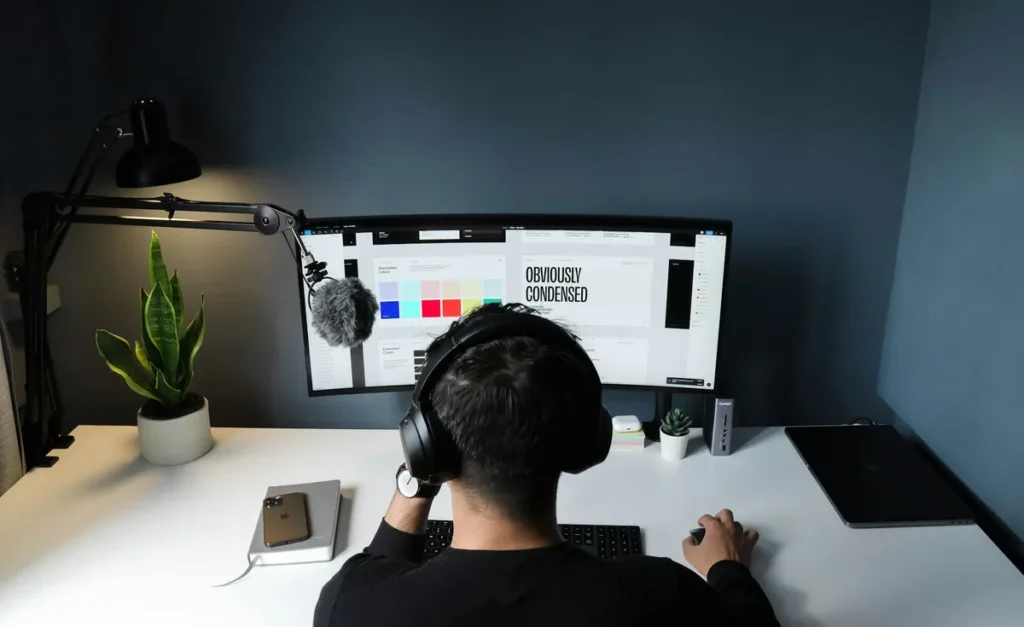
The third factor to take into consideration when deciding between custom vs. template websites is your brand equity. This is what makes B2B competitors stand out in the crowded markets in which they operate.
If brand positioning, authority, and differentiation are part of your company’s objectives in designing a website, then a custom website is your only choice.
The Limits of a Template-Based Design
Template-based websites are often unable to convey the uniqueness of a brand. They simply do not afford you the level of personalization necessary to design a website that reflects your brand’s identity and what makes you different from others.
Instead, you have to force your brand identity to fit into the rigid structure available via the template, and it just isn’t the same.
What’s more? There is no restriction on who can get a template design, so somebody in a different industry may end up using the same design as you, making your brand appear generic. That’s a trust-killer.
Worse still, your competitor can choose the same design as you. That kills your chance to stand out from the competition, and you don’t want that.
Custom Design Boosts Engagement By 356%
Why a Custom Website is Better for Brand Distinction
Comparatively, a custom website gives you a blank slate. It allows you to create a truly distinct experience that builds an emotional connection with your customers. These unique details signal high quality and can help boost user trust.
Again, a custom site can structure the page to follow your specific sales pitch. You can guide the user through a narrative journey that educates them before asking for the sale. This often leads to higher conversion rates for custom sites.
Summary: The benefits of custom vs template websites heavily favor custom when brand perception affects the bottom line.
4. Features and Integrations
Beyond the look and feel of the website is its functional capability. This is where templates can truly become a liability.
Mobile Responsiveness
To start with, some templates do not work as well on mobile as they do on desktop. Considering that mobile traffic accounts for more than 50% of all internet use these days, a template that isn’t responsive will hurt your brand.
Comparatively, custom sites are tested rigorously across device labs to ensure cross-device compatibility and mobile optimization. This guarantees that the quality of the website is maintained regardless of the device.
E-Commerce Integration
If you are looking to do any sort of serious e-commerce or integrate complex backend tools, a custom site is a must.
Template-based sites are not flexible enough. Instead, they depend on plugins for functionality, and where custom features are required, these plugins need to be hacked, resulting in unstable code.
On the other hand, a custom website permits API integration due to its complex backend. Such a build guarantees data integrity while allowing you to natively incorporate any feature you deem fit.
Security Vulnerabilities
Perhaps the most overlooked factor in the custom vs. template debate is the issue of security. Hackers love template-based sites, and it’s easy to understand why.
If a hacker can find a security vulnerability in a particular plugin, he can automate an attack on as many sites that use that particular plugin. Stats suggest that up to 96% of WordPress vulnerabilities come from third-party plugins rather than the actual software.
Comparatively, custom websites are a harder target for hackers since they are hard-coded, reducing the number of places where malicious actors can target.
User Experience (UX) Control
This is another area where custom websites win over templates. With a template, the user flow is pre-determined by the template builder. Consequently, users may need to click more times than necessary to reach their goal on your website.
However, a custom website is different. You can architect the path of least resistance and drive users towards the desired action at your pace. This allows you to optimize your site’s ability to capture leads and make sales.
5. Plans for Scalability
Finally, we must look at the potential of the website to scale with your brand.
Why Scaling With a Template-Design is Difficult
Website templates are pre-built with many features, so they can appeal to a large number of people at the same time. Even when these features are not relevant to you, they remain in the background, causing a bloating of your codebase.
As your website traffic grows, this bloated code affects its performance, slowing down your page speed. If the unused scripts result in your website loading for up to 4 seconds, your SEO rankings may drop, considering Google penalizes slow websites.
Other than the bloated code, the extra features can create coding conflicts down the road. Trying to fix these issues can consume a lot of maintenance hours and funds that could have been spent on getting it right at the outset.
Thus, a template-based site might seem like the best for your current needs, but what happens when your company starts to grow?
Scaling with a Custom Website
A custom website, on the other hand, gives you the flexibility to work with your budget and add new features whenever you need them. This allows your website to scale with you. Even when user traffic increases, custom sites have no inherent functional limitations but are instead optimized for the best performance from the beginning.
Again, modern custom builds can use the Headless Architecture that allows you to push your content to multiple channels at the same time without the need to change the underlying codebase. This is something standard templates cannot support.
Custom vs. Template Websites: Pros and Cons Summary
To make it easier for you to choose, let’s summarize the advantages of custom vs. template websites in a direct comparison.
Template Websites
Best For: Startups, Local Small Businesses, Low-Budget Projects (<$20k), Short Duration (<1 Month).
Pros of Template Websites
- Significantly lower upfront costs.
- Can be deployed in days or weeks.
- Requires less technical knowledge to set up.
- You can see exactly what the site will look like before you buy.
Cons of Template Websites
- Hard to stand out from competitors
- Slow website speed due to bloated code.
- Relies heavily on plugins, increasing the risk of hacking.
- Custom features are difficult to add without breaking the site as the business scales
- Frequent plugin updates can break the site layout, increasing time and spending on maintenance.
Custom Websites
Best For: Mid-Market Companies, E-Commerce, SaaS, High-Growth Startups ($3M+ Revenue).
Pros of Custom Websites
- Reduced security vulnerabilities
- Built to grow with your business.
- Easy integration with CRMs, ERPs, and APIs.
- Distinct web design that validates the brand’s projected authority.
- The website code and intellectual property belong solely to you.
- Custom code, semantic HTML, and schema markup lead to better website performance and SEO rankings.
Cons of Custom Websites
- Requires a budget of at least $30k
- Takes a longer time to build properly.
- You need to partner with an expert developer or agency
Get a Custom Website With Blacksmith
Clearly, the choice between a custom vs. template website is a no-brainer if you know which questions to ask.
Provided you aren’t limited by budget or an emergency timeline, a custom website is nearly always the best choice. It is built specifically for your needs, tailored to your brand’s unique identity and positioning, and configured to grow with you.
As a premier Custom Web Design Agency, Blacksmith Agency specializes in helping mid-market and high-growth companies transition from template-based web experiences to custom-coded digital websites.
If you are ready to build a website that works as hard as you do, let’s talk. We will conduct a free audit of your web infrastructure and provide you with a roadmap for levelling up your web presence.