


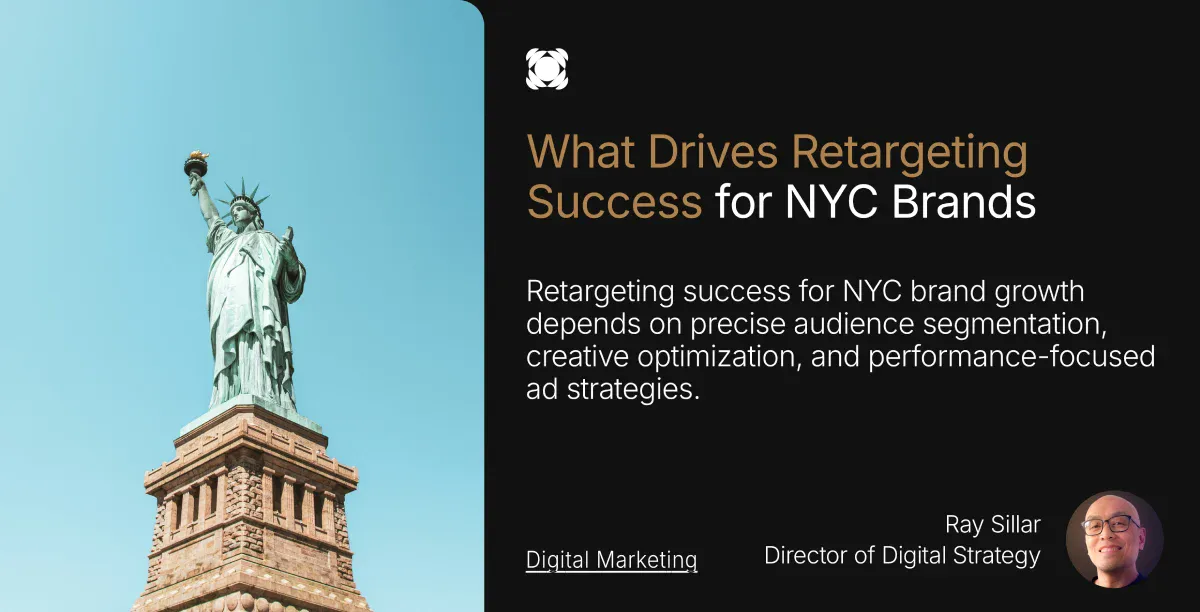
Retargeting success for NYC brands is no longer optional. It’s a foundational performance driver in one of the most competitive markets in the world. Brands can’t lose high-intent visitors after just one interaction. In a city where attention is split across devices, platforms, and environments, this is crucial.
The key difference between stale campaigns and scalable growth is how well a brand reengages users who are already interested.
New York City presents a uniquely complex digital ecosystem. Consumers move quickly, competition is relentless, and expectations for personalization are significantly higher than the national average.
Retargeting strategies that succeed in other markets may not work well in NYC. They need to be adjusted for local behaviors, industry saturation, and how people use multiple channels.
To understand what makes retargeting successful for NYC brands, we need to look closely at:
- Data infrastructure
- Audience segmentation
- Creative strategy
- Timing
- Cross-channel orchestration
It is not about showing the same ads again; it’s about delivering the right message to the right audience, at the right moment, with enough contextual relevance to convert.
Are you trying to improve your retargeting strategy but don’t know where to start? Let us help.
Why Retargeting Matters More in NYC Than Anywhere Else
In most markets, retargeting is a way to improve efficiency. In NYC, it’s often the difference between profitability and wasted ad spend. The sheer density of brands competing for attention means that initial acquisition costs are high, and users rarely convert on their first try.
Without an in-depth retargeting framework, brands are effectively paying premium prices for incomplete customer journeys.
The consumer journey in NYC is also nonlinear. A user might find a brand through a paid social ad while commuting. Later, they could revisit the website on a desktop at work. Finally, they may convert after seeing a retargeted ad on a streaming platform at night.
This fragmented journey makes retargeting not just useful, but essential for stitching together the full conversion path.
Additionally, NYC audiences are more desensitized to generic advertising. They are exposed to it all day, which means that only highly relevant, well-timed retargeting efforts break through. This elevates the importance of personalization and creativity as the main drivers of retargeting success for NYC brands.
The Role of First Part Data in Retargeting Performance
You cannot have a high-performing retargeting strategy without data, especially first-party data. As privacy regulations evolve and third-party cookies become less reliable, NYC brands are increasingly relying on their own data to power these efforts.
First-party data provides important details that help in a saturated market. These insights let brands understand not only who their users are, but how they behave across all touchpoints. This includes page-level engagement, time -on-site metrics, product interactions, and previous purchase behavior.
For retargeting success for NYC brands, the quality of the data matters far more than its quantity. As a web design agency, we constantly see that brands that invest in clean data pipelines, server-side tracking, and integrated CRM systems can build more accurate audience segments.
These segments, in turn, enable more tailored messaging that aligns with user intent from the start.
For example, a user who abandons a high-value product page requires a different approach than one who only visits the homepage. Without granular data, these distinctions are lost, leading to generic campaigns that don’t target any user in particular and fail to convert because of it.
Advanced Audience Segmentation as a Competitive Advantage
Segmentation determines whether many retargeting strategies succeed or fail. In NYC, where user intent varies widely across industries and demographics, broad audience pools dilute effectiveness. Precision segmentation is what transforms retargeting from a basic reminder into a conversion engine.
Effective segmentation goes far beyond simple categories like “site visitors” or “cart abandoners.” It involves layering behavioral, temporal, and contextual data to create highly specific audience groups.
For instance, segmenting users based on recency of interaction, frequency of visits, and depth of engagement allows brands to tailor messaging with far greater accuracy.
A user who checked the pricing page several times in the last 48 hours shows strong interest in buying. So, they should receive focused messages to encourage their decision. However, a user who briefly browsed content weeks ago may require a softer, awareness-driven approach.
Retargeting success for NYC brand strategies depends on this level of nuance. The more detailed and refined the segmentation is, the more relevant the messaging becomes, and the higher the likelihood of conversion.
Creative Strategy: The Overlooked Driver of Retargeting Success
While data and segmentation are critical, creative execution often determines whether a retargeting campaign actually converts. In NYC, where audiences are exposed to sophisticated advertising across industries, creative fatigue sets in quickly.
Successful retargeting campaigns require continuously evolving their creative assets. These evolutions include variations in messaging, visuals, formats, and calls to action.
Dynamic creative optimization plays a vital role here, allowing brands to adjust ad components based on how users react to the brand and its ads.
For successful retargeting, ad creative must also reflect the user’s position in the funnel. Early-stage retargeting might focus on brand storytelling or value propositions, while late-stage efforts should emphasize urgency, incentives, or social proof.
Equally important is contextual relevance. Ads that align with the user’s previous interactions will always feel more personalized and less intrusive.
Timing and Frequency: Find the Ideal Conversion Window
Timing is one of the most underestimated factors in retargeting. Showing the right ad at the wrong time can be just as ineffective as showing the wrong ad altogether. In a fast-paced market like MYC, where consumer attention shifts rapidly, timing becomes even more critical.
Conversion windows are central to retargeting success for NYC brand strategies. This refers to the period during which a user is more likely to convert after an initial interaction. Identifying and targeting within this window requires analyzing historical data and user behavior patterns.
Frequency also plays a significant role. With few to no impressions, the brand is easily forgotten; too many and the user becomes annoyed. Achieving the right balance requires continuous optimization and monitoring.
Advanced platforms allow for frequency capping and sequential messaging, ensuring that users are not overwhelmed while still maintaining visibility.
Sequential retargeting, in particular, is highly effective in NYC. By delivering a series of ads that build on each other, brands can guide users through the decision-making process rather than relying on a single message to drive conversions.
Cross-Channel Retargeting in a Multi-Platform City
NYC consumers do not use a single platform. They move seamlessly between social media, search engines, email, streaming services, and even physical environments. This makes cross-channel retargeting a necessity, not a luxury.
A strong retargeting strategy ensures that users are consistently encountering your messaging across platforms. Don’t just repeat the same ad everywhere. Instead, adjust the message for each channel. Keep a consistent story throughout.
For example, a user might see a visually engaging product ad on Instagram, followed by a more detailed ad while conducting a search on Google, and finally a conversion-focused ad via email.
Every single touchpoint reinforces the previous one, increasing the likelihood of conversion.
Retargeting success for NYC brand campaigns is often tied to how well marketing channels are integrated and synchronized. Coordinated efforts create smooth experiences. This builds trust and inspires action. In contrast, disjointed efforts lead to confusion.
The Impact of Personalization on Conversion Rates
Personalization is no longer optional; it’s expected. NYC consumers, in particular, are accustomed to highly tailored experiences and are quick to ignore is the messaging is generic. Retargeting provides a unique opportunity to deliver personalized content at scale.
Personalization can take several forms, from dynamic product recommendations to location-based messaging. For NYC brands, incorporating local context can be especially effective.
Referencing specific neighborhoods, events, or cultural touchpoints adds a layer of relevance that resonates with users.
However, true personalization goes beyond surface-level adjustments. It involves understanding user intent and delivering messaging that fully aligns with their specific needs and preferences.
This requires a combination of data analysis, creative strategy, and technological infrastructure.
When properly done, personalization drives retargeting success for NYC brand campaigns. This approach drastically improves engagement and conversion rates.
Measuring Retargeting Performance Beyond Clicks
One of the biggest mistakes brands make is evaluating their retargeting performance based only on clicks or conversions. While these metrics are very important, they don’t capture the full impact of your retargeting efforts.
In NYC, where customer journeys are complex and multi-touch, it is essential to take a broader view of performance indicators. These include view-through conversions, assisted conversions, and lifetime value. Retargeting often plays an important role in the conversion process, influencing decisions even when retargeting is not the final touchpoint.
Attribution modeling is a must in this context. Multi-touch attribution provides a more accurate picture of how retargeting contributes to overall performance. Brands that rely on last-click attribution risk undervaluing their retargeting efforts and making poor budget decisions.
Common Pitfalls That Sabotage Retargeting Campaigns
Despite all of its potential, retargeting is commonly misused. One of the most common issues we see is the overreliance on broad audience pools. This approach is not effective and leads to generic messaging that tries to satisfy everyone.
Another very common mistake we see all the time is failing to refresh creative assets after a while. This generally results in ad fatigue and diminishing returns
Poor data quality is also a big obstacle since inaccurate or incomplete data results in ineffective segmentation and wasted ad budget. In a similar vein, a lack of coordination across all channels can create inconsistent user experiences that hinder conversion.
Perhaps the biggest mistake is treating retargeting as a static tactic rather than a dynamic strategy. The NYC market evolves quickly, and what works today may not work tomorrow. Ongoing optimization and iteration are essential for maintaining performance.
The Future of Retargeting for NYC Brands
As technology and consumer behavior evolve, so too will retargeting strategies. The shift toward privacy-first frameworks is already reshaping how data is collected and used. This will place even greater emphasis on first-party data and contextual targeting.
Artificial intelligence and machine learning are also starting to play a vital role in retargeting. These technologies now allow for more sophisticated segmentation, predictive modeling, and even real-time optimization. For NYC brands, adopting these tools will be vital for staying competitive.
Additionally, the integration of offline and online data will open new opportunities for retargeting. In a city where physical and digital experiences are deeply intertwined, bridging this gap can offer a more comprehensive view of the customer journey.
Retargeting success for NYC brands will mainly depend on how well brands adapt to all of these changes. Brands that understand and invest in data infrastructure, creative innovation, and cross-channel integration will be best positioned to grow in the coming years.
Get a Custom Retargeting Strategy That Converts With Blacksmith
After going through this article, it might become clear that retargeting success for NYC brands is far more complex than it seems. Success doesn’t come from a single tactic or platform. Instead, it’s a result of a well-thought-out strategy that combines data, segmentation, creative execution, timing, and measurement.
But we’ll be honest with you, creating a retargeting strategy that works in NYC is not an overnight task. In fact, it can take you weeks to develop a strategy. This is time you could be using on other aspects of your business, so now what?
That’s where we come in. Blacksmith is an NYC Digital Marketing Agency of experts ready to create the perfect retargeting strategy for your business.
Still unsure if a custom retargeting strategy is what your NYC brand needs to grow? Don’t worry, schedule a call with us, and we’ll provide you with a full website and brand audit. This way, we can show you where your ads are failing and how we can improve them with a new strategy.