



Your customers don’t really care about your marketing channel. They don’t think about whether they’re on your website, your Instagram, or standing in your store. To them, it’s all one experience.
And when that experience feels disconnected or inconsistent, they notice. They just don’t always tell you. This is what an omnichannel strategy fixes. It takes every place your customer interacts with you and ties it all together into something that feels like one brand, one conversation, one relationship.
If you’re a brand owner or a marketer trying to figure out how to make this work in 2026, this guide is for you. No fluff, just a clear path from where you are now to where your customers already expect you to be.
Trying to improve your website, but don’t know where to start? Let us help.
What Does Omnichannel Strategy Actually Mean?
Let’s get the definition out of the way, because this term gets thrown around a lot, and most people don’t clarify it at all.
An omnichannel strategy is a way of running your marketing, sales, and customer service so that every channel works together as one connected system.
Your website knows what happened in your store. Your emails know what someone browsed on your app. Your support team knows what a customer said on social media last week.
This differs from the setup most brands use, which is a multichannel setup. Multichannel means you’re present on many platforms, such as email, social, your website, and maybe a physical location, but each one operates on its own. They don’t share information or coordinate.
This means that the customer has to start over every time they switch from one to another. An omnichannel approach closes that gap since it creates one continuous experience no matter where, when, or how someone interacts with your brand.
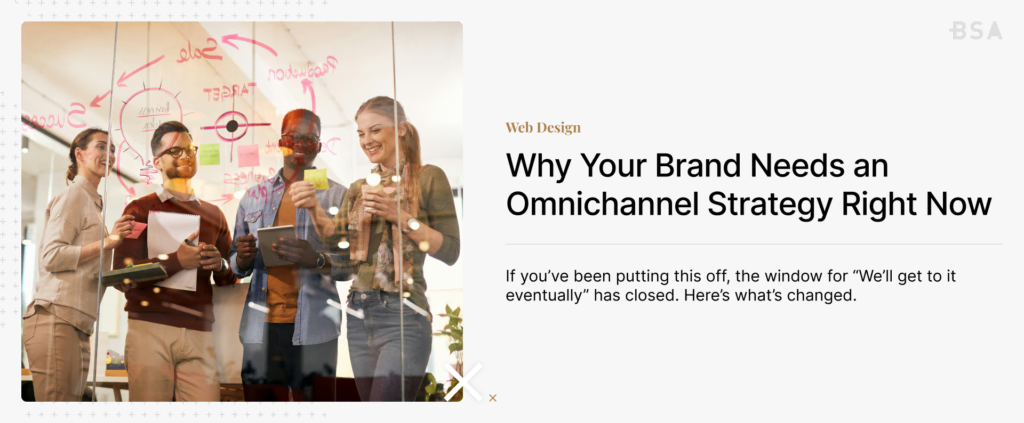
Why Your Brand Needs an Omnichannel Strategy Right Now
Privacy Rules Have Changed the Playbook
Third-party cookies are gone. Tracking people across the internet, the old way doesn’t work anymore. The brands winning now are the ones collecting their own data through loyalty programs, email signups, app usage, and in-store interactions.
An omnichannel strategy is what lets you pull all of that first-party data together into something useful instead of letting it sit in disconnected spreadsheets and dashboards.
Your Customers Move Fast
The average person in 2026 bounces between six-plus platforms in a single day. They might discover you on TikTok, check your reviews on Google, visit your site on their laptop, and buy through your app on their phone, all in the same week.
Without an omnichannel strategy, each of those moments exists in a vacuum. With one, they build on each other.
AI Only Works With Connected Data
If you’re using AI tools for personalization, email automation, chatbots, or product recommendations, those tools are only as good as the data behind them. Disconnected channels mean disconnected data, which means your AI is guessing instead of knowing. An omnichannel strategy gives your tools the full picture they need to actually be helpful.
The Numbers Don’t Lie
Customers who interact with a brand across multiple connected channels spend significantly more than single-channel customers. They’re also more loyal and more likely to refer others.
When marketing budgets are under pressure, and every dollar has to justify itself, an omnichannel strategy is one of the few investments that pays for itself by improving acquisition, retention, and lifetime value.
How to Build an Omnichannel Strategy: A Step-by-Step Breakdown
Building an omnichannel strategy takes time, but the process shouldn’t be overwhelming. Break it into stages and tackle them one at a time.
Explore how we increased Laitek’s engagement rate by 104% with a new web design in our latest case study.
Step 1: Map Everything You Have
Before you start building anything new, get a clear picture of your current setup. Write down every channel where customers interact with your brand. That includes your website, social media accounts, email, SMS, live chat, phone support, physical stores, third-party marketplaces like Amazon, and anywhere else your brand shows up.
For each channel, ask yourself a few questions. Who on your team manages it? What platform or tool runs it? What customer data does it collect? And most importantly, does it connect to anything else?
Most brands find that the honest answer to the last question is “not at all.” That’s fine, as this realization can be your starting point.
Next, trace the most common paths your customer takes. How do they find you? Where do they go next? What happens between their first interaction and their first purchase? What about after the purchase?
Look for the spots where the experience breaks, where someone has to repeat their information, where context gets lost, or where the handoff between channels feels clunky or nonexistent.
This is the foundation of your omnichannel strategy. You cannot connect what you don’t understand.
Step 2: Get Your Customer Data in One Place
This is the most important technical step in the entire process. Your omnichannel strategy lives or dies by your ability to see each customer as one person across every channel.
That means you need a central system, whether that’s a Customer Data Platform, a robust CRM, or even a well-structured database, that pulls in data from everywhere and ties it to individual customer profiles.
What should those profiles include? At minimum, you want purchase history, browsing behavior, email engagement, support interactions, and communication preferences. If you have a physical location, you will want in-store activity too.
The key to this process is identity resolution. While that’s a technical term, the concept is simple: the ability to recognize that the person who opened your email this morning is the same person who visited your store last Saturday and browsed your site on their phone two weeks ago. Without this, your omnichannel strategy is incomplete. You just have a lot of data sitting in different places.
Before you start connecting systems, clean up your existing data. Duplicate customer records, inconsistent formatting, and outdated information will cause problems down the road. Sorting it out now prevents these issues later.
Step 3: Give Each Channel a Clear Job
Here’s a mistake we see all the time when brands start building an omnichannel strategy: they try to make every channel do everything. Your Instagram doesn’t need to be your customer support deck. Your email doesn’t need to replicate your entire website. Each channel has its strengths, so use them.
Think about it in terms of roles. Your website is most likely your best tool for education and conversion. Your app might be the best for loyalty and repeat purchases. Social media is strong for awareness, community, and brand personality. Email is great for nurturing relationships and driving specific actions. SMS works for time-sensitive updates. And if you have a physical location, it’s your best channel for high-touch personal experiences.
When you define these roles correctly, your team knows what to focus on, and your customer gets the right experience in the right place. An omnichannel strategy layer is what ensures information flows between those roles so nothing falls through the cracks.
Step 4: Align Your Team Around the Customer, Not the Channel
This is where a lot of omnichannel strategies stall, not because of technology, but because of people.
In most organizations, teams are structured around channels. You have an email team, a social team, a paid ads team, and a retail team. Each one has its own goals, its own budget, and its own way of measuring success. The problem is that nobody owns the overall customer experience. Everyone owns a part of it, and the pieces don’t always fit together.
To make your omnichannel strategy work, you need to shift the focus from channels to customers. That doesn’t mean restructuring your entire company, though. It can start with something as simple as shared dashboards, regular cross-team meetings, and a single set of customer experience goals that everyone contributes to.
The mindset shift matters more than overall organizational change. When your email marketer knows what the social team is running this week, and your support team can see what campaigns a customer received before they called in, everything gets better and a lot more efficient.
Step 5: Choose the Right Technology
You don’t need to rip out your entire tech stack to build an omnichannel strategy, but you do need your tools to talk to each other.
Start with what you have. Most modern marketing platforms, call tracking metrics (CTMs), and eCommerce systems offer integration or APIs that let them share data. Remember that the goal is to create a connected ecosystem where customer information flows freely between your tools.
Here’s what we recommend prioritizing. First, your central customer database (CDP or CRM). This is the hub. Everything else will connect to it. Second, your marketing automation platform, whatever you’re using to send your emails, trigger SMS, and run workflows, needs to pull from a push to your central database in real time.
Third, your analytics. You need a way to see the full customer journey across channels, not just channel-by-channel performance.
If you’re considering new tools, the single most important question to ask is “how easily does this integrate with what we already have?” A flashy platform that lives on its own island is the opposite of what your omnichannel strategy needs, for example.
And a note on AI, in 2026, most major marketing platforms will have AI features already built in, such as predictive segmentation, content optimization, smart send times, and automated personalization.
These features are powerful, but only if they’re connected to your unified data. Make sure any AI tool you adopt can access your full customer picture, not just one channel’s worth of information.
Step 6: Create Consistent Messaging With Room to Adapt
An omnichannel strategy doesn’t mean saying the exact same thing everywhere. It means your brand voice, your core message, and your visual identity are consistent, while the format and delivery adapt to fit each channel.
A product launch might look like a polished email campaign, a series of short-form videos on social media, a homepage banner on your site, and a display at your physical store. In each case, the look and feel should be recognizable across all of them. At the same time, your email can be even more specific. The videos can focus on emotion. The in-store display can be experiential.
Create a messaging framework for your major campaigns and initiatives. Define the core message, the key proof points, and the brand voice guidelines. Then let each channel team adapt that framework to their specific format.
This gives you consistency without a feeling of rigidity, which is exactly what a good omnichannel strategy offers.
Step 7: Personalize Based on Real Behavior
Personalization is one of the biggest benefits of an omnichannel strategy, and in 2026, customers expect it. But good personalization isn’t about being creepy; it’s about staying relevant.
Use the unified data you’ve built to tailor experiences based on what people actually do, not just who they are demographically. Someone who keeps browsing a specific product category should see more of that category in their recommendations. Someone who always opens emails on weekday mornings should get their email on weekday mornings. Someone who made a purchase last week should get a follow-up that acknowledges that purchase, not a generic thank-you message.
The goal is to make personalization feel helpful, not intrusive. A customer should think “this brand gets me,” not “this brand is watching me.” That balance comes from personalizing based on behavior and preferences rather than personal details.
And here’s where your omnichannel strategy really shines: because you have data from multiple channels feeding into one profile. This means that your personalization is based on a much fuller picture of each person. It’s not just what they did on your website; it’s everything, and this leads to recommendations and messages that actually land.
Learn how we increased bulbs’ average engagement by 50.2% with a new web design in our latest case study
Step 8: Test, Measure, and Improve
An omnichannel strategy isn’t a set-it-and-forget-it project. You should always consider refining it.
Start by defining your most important metrics. The most important ones to track can include customer lifetime value, cross-channel conversion rates, retention rates, and customer satisfaction scores.
These metrics tell you whether your connected experiences are actually driving results or not.
Beyond the top-level numbers, pay attention to where the handoffs are. Are people dropping off when they move from social to your website? Are your email-to-app conversions weak? Are support interactions ending poorly because agents don’t have the necessary context? These friction points are where you’ll find the biggest opportunities for growth.
Run A.B tests across channels. Try different messaging sequences, different timing, different levels of personalization. See what works, and feed those insights back into your omnichannel strategy. The brands that win long-term aren’t the ones that launch perfectly; it’s the ones that iterate faster.
Common Mistakes to Avoid
There are a few traps that brands fall into when building an omnichannel strategy for the first time. Here are the most common ones to watch for.
Trying to Do Everything at Once
You don’t need to connect every channel and have a strategy in place on day one. Start with the two or three channels your customers use the most and go from there. A phased approach is almost always a lot easier to sustain and more successful than a massive overhaul.
Focusing on Technology Over Experience
It’s easy to get caught up in technical platforms and integrations and forget what you’re actually trying to do, which is to make your customers’ lives easier. Before you buy any new tool, ask yourself if it improves the experience for the person on the other end. If you don’t have a good answer, then it can wait.
Ignoring Your Team’s Buy-In
Your omnichannel strategy will fail if the people executing it don’t understand it or believe in it. Take time to explain the “why”, not just the “what”. Show your team how connected channels make their jobs easier and their results better. Get their input on where the current experience breaks down, since they usually know better than anyone else.
Measuring Channels in Isolation
If you’re still judging each channel by its own individual performance alone, then you’re going to make costly mistakes. A social media post that doesn’t convert directly might be the first touchpoint in a journey that leads to a high-value purchase through email two weeks later. Your measurement framework should reflect the full journey, not just the last click.
Treating Omnichannel as a Marketing-Only Initiative
Your omnichannel strategy needs to extend well beyond the marketing team. Sales support, product, and operations should all play a role in the customer experience. If marketing builds a connected journey, but support can’t see the customer’s history, the whole thing falls apart at the moment it matters most.
What a Great Omnichannel Strategy Looks Like in Practice
Let’s paint a quick picture so you can see how all of this comes together.
A customer discovers your brand through a social media ad. They tap through to your site, browse a few products, but don’t buy. Your system recognizes them through a cookie or a pixel and adds their browser activity to their customer profile.
Two days later, they get an email, not a generic blast, but a message highlighting the products they looked at, along with a few related items. They click through and add something to their cart, but get distracted and leave.
Your app sends a push notification later that day with a simple reminder. They open the notification, complete the purchase, and opt into your loyalty program at checkout.
A week later, they walk into your physical store to return the product. The associate pulls up their profile, sees their purchase history and loyalty status, processes the return without friction, and suggests an alternative product based on their browsing history. The customer walks out with a new item and a better impression of your brand than they had before.
That’s an omnichannel strategy at work. Every single touchpoint is connected. Every interaction builds on the last, and the customer never once has to explain themselves or start over.
Get a New Website That Connects Perfectly With Your Omnichannel Strategy With Blacksmith
After going through this article about how to create an effective omnichannel strategy, it’s clear that working on this isn’t a weekend project. It’ll take weeks, if not months, of preparation and work.
This is without even considering that each channel should be worked on individually to ensure it is ready for use in an omnichannel strategy. The biggest “channel” by far is your website.
But let’s face it, redesigning or ensuring that your website meets every standard possible is tough. So what now?
That’s where we come in. Blacksmith is a B2C Website Design Agency with a group of professional web designers and developers dedicated to creating the perfect website for your brand and your omnichannel strategy.
Are you still unsure if a new B2C website is what your business needs to thrive? Don’t worry; schedule a call with us, and we’ll provide you with a free website audit. This way, we can show you the areas where a lack of a good website is not only hurting your omnichannel strategy but your brand as a whole.